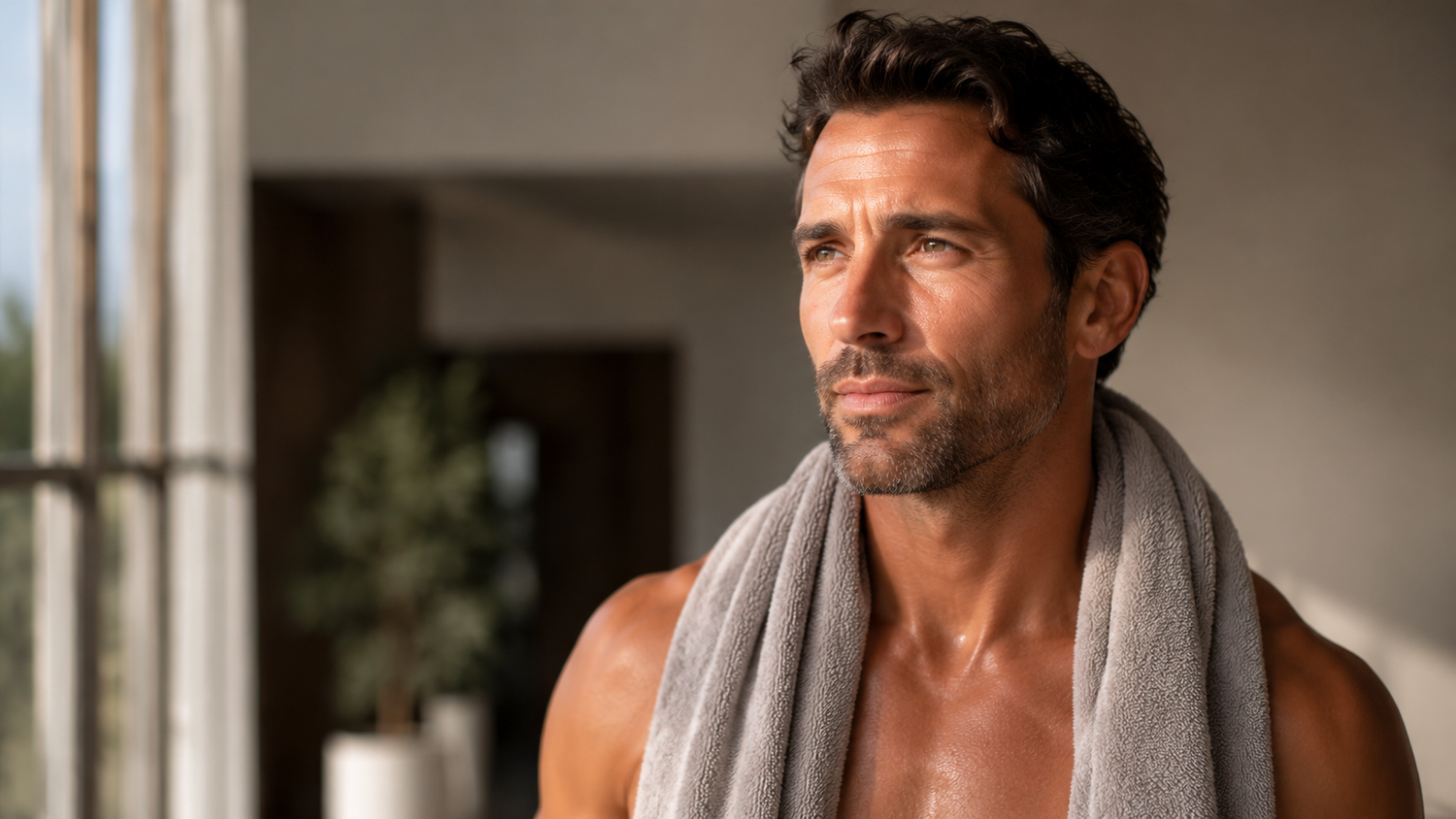
Red light therapy has a marketing problem: most of the imagery aimed at it shows women doing skincare. That has left a lot of men assuming it is not for them. It is - the underlying biology has nothing to do with gender. If you care about training recovery, thinning hair, joint niggles or just skin that looks less tired, the same wavelengths of light apply to you as to anyone else.
This guide cuts through the noise. Here is what red light therapy may actually do for men, what the research supports, and where the internet is overselling it - including the testosterone claims you have probably seen on social media.
What red light therapy actually is
Red light therapy (also called photobiomodulation or low-level light therapy) uses specific wavelengths of red and near-infrared light - typically around 660nm and 850nm - delivered to the skin. The light is absorbed by the mitochondria in your cells, the tiny structures that produce energy. Research suggests this can support cellular energy production and help the body's normal repair processes.
It is not heat, it is not UV, and there is no downtime. You sit or stand in front of a panel, or wear a mask or wrap, for a few minutes at a time. That simplicity is a big part of why it has moved from clinics into homes.
1. Muscle recovery and training performance
This is the strongest, most practical reason for active men to pay attention.
A body of research on photobiomodulation and exercise suggests that red and near-infrared light applied around training may support faster recovery and reduce the muscle soreness that shows up a day or two after hard sessions. The proposed mechanism is the same one above - supporting mitochondrial energy output and helping manage the normal inflammation that follows intense exercise.
What that means in plain terms: if you lift, run or play sport and you are chasing consistency, better recovery between sessions is the lever that lets you train more often without breaking down. Red light will not replace sleep, protein or sensible programming, but it is a low-effort addition to the recovery stack.
For targeted areas - a stubborn shoulder, lower back or quads after leg day - a wrap or red light therapy belt delivers light directly to the working muscle. For whole-body coverage, a full-size panel is the more efficient route. Our guide on red light therapy before or after a workout breaks down the timing.
2. Joint and back pain
Men accumulate wear-and-tear injuries - dodgy knees, tight lower backs, tennis elbow that has nothing to do with tennis. Red and near-infrared light, particularly the deeper-penetrating 850nm wavelength, has been studied for its role in supporting comfort and recovery in aching joints and soft tissue.
The evidence here is more established than in some other areas because it overlaps with decades of clinical work on low-level laser therapy for musculoskeletal complaints. It is not a cure and it will not fix a structural problem that needs a physio or surgeon, but as a daily comfort tool for the general aches of an active or desk-bound life, it is a reasonable option. See our detailed pieces on joint pain and stiffness and back pain.
3. Hair thinning
Male pattern hair loss is one of the highest-volume reasons men search for red light therapy - and it is a genuinely researched application, though with an important caveat.
Low-level laser and LED therapy for hair has clinical support: studies suggest specific red wavelengths may help support hair density in people with androgenetic alopecia by stimulating activity in the hair follicle. This works best in the early-to-mid stages of thinning, not on areas that are already fully bald, where there are no active follicles left to stimulate.
The caveat: hair growth devices are typically purpose-built caps, helmets or combs that sit against the scalp, not face masks or body panels. If hair is your primary goal, look specifically at scalp-targeted red light devices rather than assuming a general panel will do the job. It is an area where matching the tool to the target matters. Our clinical evidence round-up on hair growth covers what the studies actually found.
4. Skin - yes, men have skin too
Men's skin ages the same way everyone's does: collagen production drops, fine lines set in, and sun damage from years of not wearing SPF starts to show. Red light therapy is one of the better-evidenced tools for supporting the appearance of ageing skin, because red wavelengths around 660nm may help stimulate fibroblast activity - the cells responsible for collagen.
You do not need a shelf of serums to benefit. A few minutes with an LED face mask a few times a week is about as low-maintenance as skincare gets, which suits most men fine. It may help with the appearance of fine lines, tired-looking skin and overall tone over consistent use. For the science, see red light therapy and collagen.
5. The testosterone question - read this carefully
You have almost certainly seen the claim: shine red light on your testicles, boost your testosterone. It is all over social media, usually attached to a supplement funnel or a "biohacking" course.
Here is the honest position. The idea comes from a small number of early, mostly animal studies and some in-vitro work suggesting light exposure might influence certain cells involved in testosterone production. That is a very long way from proof that shining an LED panel at your groin measurably raises testosterone in healthy men. There are no large, well-controlled human trials demonstrating a meaningful, lasting effect, and the practice carries obvious sensitivity concerns for a delicate area.
Our take: treat the testosterone claim as unproven marketing, not established science. If you want the well-supported benefits - recovery, joints, skin, and hair with the right device - they stand on their own. Do not buy red light therapy expecting a hormone boost. If low testosterone is a genuine concern, that is a conversation for your GP, not an LED panel.
How men should actually use it
- For recovery: target the trained muscle groups for a few minutes after sessions, or do a general panel session daily. Consistency beats intensity.
- For joints: apply to the specific area daily during a flare, then a few times a week for maintenance.
- For skin: a face mask 3 to 5 times a week, consistently, over 8 to 12 weeks before judging results.
- For hair: use a scalp-specific device as directed, and be realistic - it supports existing follicles, it does not resurrect dead ones.
The single biggest predictor of whether red light therapy works for anyone, of any gender, is consistency. It is a slow, cumulative tool, not a one-session fix.
Is it safe for men?
For the vast majority of people it is well tolerated. Red and near-infrared light is non-UV, so it does not carry the skin-cancer risk of tanning. The main sensible precautions: use eye protection or keep eyes closed with bright panels, do not use it over active skin cancers or on areas being treated with photosensitising medication, and start with shorter sessions. Our safety and contraindications guide covers who should be cautious.
The bottom line
Red light therapy is not a gendered product - the biology is the same for everyone. For men, the strongest reasons to use it are muscle recovery, joint and back comfort, ageing skin, and early-stage hair thinning (with the right scalp device). The testosterone hype is the one claim to ignore. Buy it for what the evidence supports, use it consistently, and give it time.
Frequently asked questions
Does red light therapy work for men?
Yes - the biological mechanism is identical regardless of gender. Men most commonly use it for muscle recovery, joint and back comfort, skin ageing and early-stage hair thinning.
Can red light therapy boost testosterone?
There is no strong human evidence that it does. The claim comes from small early studies and is best treated as unproven marketing rather than established science. For genuine testosterone concerns, speak to your GP.
Is red light therapy good for muscle recovery?
Research on photobiomodulation suggests it may support faster recovery and reduce post-exercise muscle soreness when used around training. It works best as part of a wider recovery routine, not as a replacement for sleep and nutrition.
Can red light therapy help men's hair loss?
Studies suggest specific red wavelengths may help support hair density in early-to-mid androgenetic alopecia. It works best with a scalp-specific device and on areas that still have active follicles, not fully bald patches.
How often should men use red light therapy?
Consistency matters more than session length. For recovery and joints, daily to several times a week; for skin, 3 to 5 sessions a week over 8 to 12 weeks before judging results.
Is red light therapy safe?
It is non-UV and generally well tolerated. Use eye protection with bright panels, avoid use over active skin cancers or with photosensitising medication, and start with shorter sessions.


Leave a comment
This site is protected by hCaptcha and the hCaptcha Privacy Policy and Terms of Service apply.