
What is a red light therapy mat?
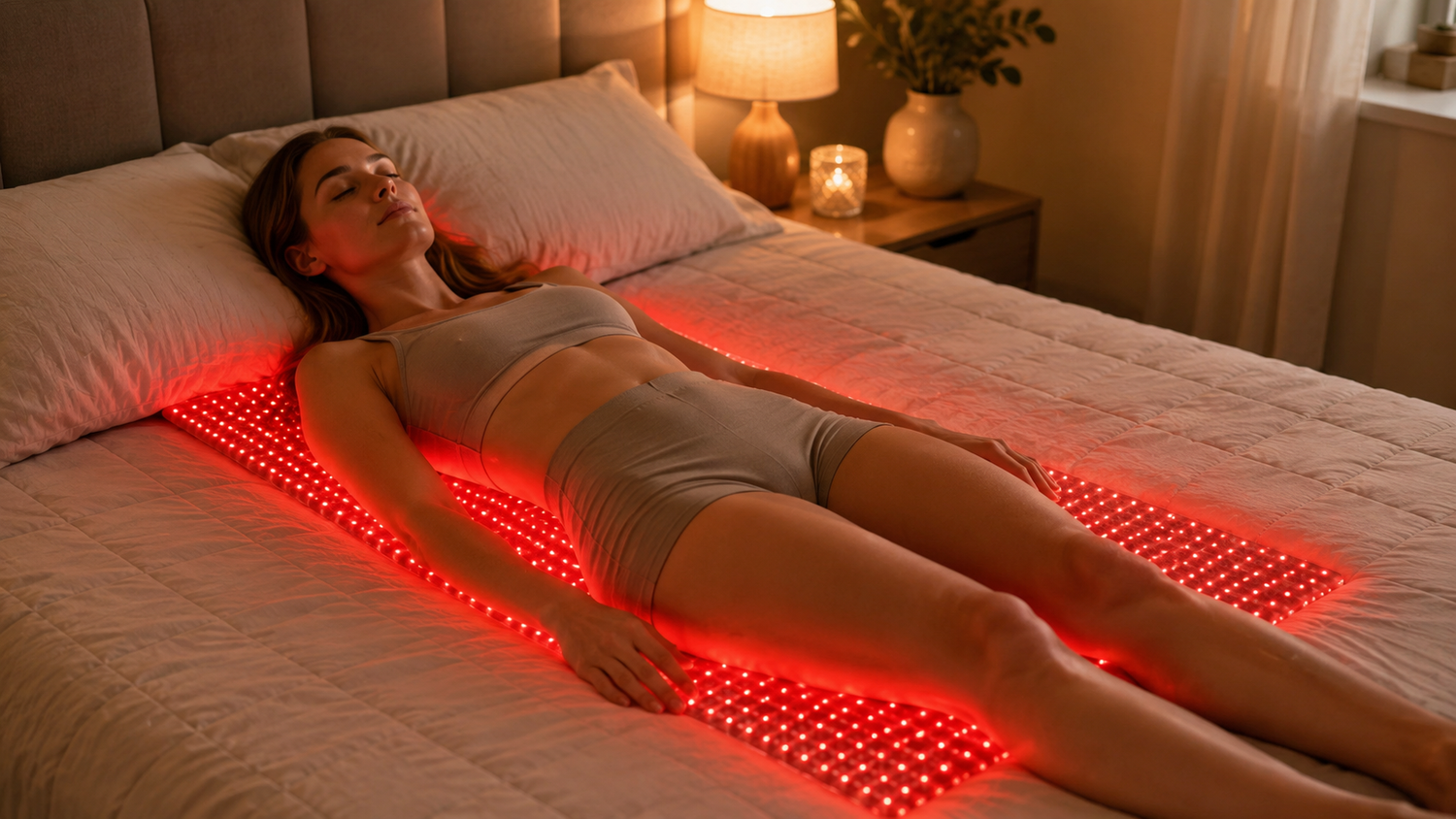
A red light therapy mat is a flexible, roll-out LED surface you lie back on, rather than a rigid panel you stand or sit in front of. Instead of aiming light at one area with your hands, you lie down on the mat and let it cover a large part of the body at once - hands-free, no holding, no standing.
Most quality mats, including the Lumovex Total Recovery Mat, use two wavelengths of light together: red at 660nm, which is absorbed close to the skin surface, and near-infrared at 850nm, which is designed to reach deeper into muscle and connective tissue. It is the same core technology used in professional LED panels, delivered in a format built for lying down and relaxing.
In the Lumovex Total Recovery Mat, that comes from 900 dual-wavelength LEDs spread across the 150 x 60cm surface, combining 660nm red light with the deeper 850nm near-infrared - the part most associated with muscle and joint recovery.
If you have looked at at-home red light and felt put off by the idea of standing in front of a panel every day, a mat is the format that tends to change people's minds. You use it while you would be resting anyway.
What does a red light therapy mat actually do?
Red and near-infrared light are absorbed by the mitochondria in your cells, the part that produces energy. Research into photobiomodulation - the science of how light interacts with living tissue - suggests this can support the way cells produce and use energy, which is why the wavelengths are studied so widely for recovery and skin.
In plain terms, here is what people typically look to a mat to support:
- Muscle recovery after training. Red light therapy is one of the most researched tools for post-exercise recovery, and mats are popular with people who want to cover large muscle groups like the back, legs and core in one go.
- General joint and muscle comfort. Studies suggest red and near-infrared light may help with the feeling of everyday aches and stiffness.
- A calmer evening routine. Because a mat session means lying still for 15 to 20 minutes, many people fold it into a wind-down habit before bed.
- Skin over a large area. The same wavelengths studied for facial skin apply to the body, so a mat covers skin across the torso and back that a face mask never reaches.
It is worth being honest about expectations. Red light therapy is a consistency tool, not an overnight fix. The people who get the most from a mat are the ones who use it steadily over weeks, not those chasing a single dramatic session.
How big are red light therapy mats, and what do they cover?
This is the question most "red light therapy mat full body" searches are really asking, so here is the straight answer: mats vary a lot in size.
Some oversized mats are designed to run from your shoulders to your feet. Others, like the Lumovex Total Recovery Mat, are a 150 x 60cm surface built to cover a large area of the body at once - how much depends on your height and how you lie on it, but it comfortably takes in the shoulders, back, chest, abdomen and hips. That is the largest single block of muscle and skin on the body, and the area most people are actually trying to reach for recovery and relaxation.
You lie down on top of the mat, LED side against your skin, the same way you would use a yoga mat or a heated underblanket - never draped over you like a blanket. Depending on your height, your lower legs may extend past the end of the mat, which is why a mat pairs so naturally with a face device for skin-focused sessions it is not built for.
So if your goal is whole-body coverage in the truest sense, you would combine a large-area mat with a face mask. If your goal is to cover the biggest muscle groups hands-free while you rest, a single mat does that on its own.
Who is a red light therapy mat for?
A mat is the right pick if you recognise yourself in any of these:
- Athletes and gym-goers who want hands-free recovery across large muscle groups after training, without standing in front of a panel.
- Busy people who only realistically have time for wellness during rest, and want a session they can do lying down.
- Anyone building an evening routine who likes the idea of 15 to 20 minutes of quiet, screen-free wind-down.
- People who dislike standing panels and would simply use a lie-down format far more often.
If your main interest is your face and neck, a mat is not your first device - a mask is. And if you only want to treat one small, specific spot, a targeted device makes more sense. A mat earns its place when you want big-area, low-effort coverage.
How to use a red light therapy mat
Getting results from a mat is refreshingly simple:
- Roll it out on a flat surface - a bed, sofa, yoga mat or the floor all work. There is no fixed installation.
- Lie down on top of it, with the LED side against bare skin. Skin contact matters, so use it on bare skin where you can rather than through thick clothing.
- Run a session of 15 to 20 minutes. Longer is not better - consistency beats marathon sessions.
- Use it 3 to 5 times a week. A steady routine over weeks is where the benefit builds.
Most people find the easiest way to stay consistent is to attach the session to something they already do - reading, a podcast, or the half hour before bed. You are not carving new time out of your day, you are layering light onto rest you were taking anyway.
Mat versus mask, panel and belt: which format suits you?
Red light works the same way across devices - the difference is coverage and how you use it. Here is how a mat fits alongside the rest of an at-home setup:
- Mat - big-area, lie-down, hands-free coverage across a large part of the body. Best for large-area recovery and relaxation while you rest.
- Spectrum Pro Mask - face-focused sessions using four wavelengths for skin tone, texture and comfort. The device a mat cannot replace for your face.
- Pro Panel 540 - a standing panel for targeted sessions where you want to aim light at a specific area on training days.
- Red Light Therapy Belt - a wraparound device for hands-free lower-back and core recovery when you want to stay mobile rather than lie down.
Plenty of people end up with two devices for different jobs - a mat for lie-down large-area recovery in the evening, and a mask for their face in the same routine. They cover different ground, so they complement rather than compete. If you are still weighing up which format to start with, our collection of best-selling red light therapy devices shows which ones UK buyers reach for most.
What to look for in a UK red light therapy mat
If you are comparing mats, these are the things that actually matter:
- Two wavelengths, not one. Look for both red (around 660nm) and near-infrared (around 850nm). Red works nearer the surface, near-infrared reaches deeper - together they cover more.
- A size that matches your goal. Decide whether you want large-area coverage or an oversized head-to-toe mat, and buy for that. Bigger is not automatically better if you only need your back and core.
- UK support and clear cover. Check for CE certification, UK-based support, a real warranty and a returns window, so you are not stuck if it is not the right fit.
- Honest guidance on use. A good mat comes with clear instructions on session length and frequency, not vague promises.
The Lumovex Total Recovery Mat covers this brief at £199: 900 dual-wavelength 660nm and 850nm LEDs, a 150 x 60cm lie-on surface, CE Certified, with a 2-year warranty, 30-day returns and free UK mainland shipping. It is built to be the low-effort, high-consistency device in your routine - the one you actually keep using.
Lumovex Total Recovery Mat: the specifications
If you like to compare the numbers before you buy, here is what the Total Recovery Mat is built from, taken straight from its spec sheet:
- LEDs: 900 LEDs across the surface
- Wavelengths: dual-wavelength 660nm red and 850nm near-infrared
- Irradiance: 11.8 to 49.3 mW/cm2 at the surface, across five intensity levels (measured at skin contact)
- Intensity control: five brightness levels, plus two pulse modes (10Hz and 40Hz)
- Power: 85W, mains-powered with an included controller
- Size: 150 x 60cm roll-out mat; how much of the body it covers depends on your height and position
- Weight: 2.2kg
- Timer: adjustable, 10 to 90 minutes
- Assurance: CE Certified, 2-year warranty, 30-day returns and UK-based support
Because the mat is a contact device you lie on, the surface irradiance is the figure that matters - the LEDs sit directly against your skin rather than at a distance. At £199, that is a genuine dual-wavelength specification at a fraction of clinic-bed pricing.
What the research does and does not support
It is worth setting expectations honestly. Studies on red and near-infrared light suggest it may support muscle recovery, general joint and muscle comfort, and relaxation routines, and many users report feeling less stiff after training and finding the evening sessions genuinely calming.
What it is not: a cure, a medical treatment, or a replacement for professional care. Red light therapy will not fix an injury, and results vary from person to person. If you are pregnant, have a specific medical condition, or take light-sensitising medication, check with a healthcare professional before starting. Used sensibly and consistently, a mat is a low-effort way to build recovery and wind-down into a normal week.
Frequently asked questions
How often should I use a red light therapy mat?
Most people get the best results from 15 to 20 minute sessions, 3 to 5 times per week. Consistency matters more than session length - a steady routine tends to deliver more than occasional long sessions.
How long until I notice a difference?
Red light therapy is a gradual support tool, not an overnight fix. Many users notice changes within 4 to 8 weeks of consistent use, such as muscles that feel more comfortable after training or an easier evening wind-down. Results vary by individual.
Does a red light mat cover your whole body?
It depends on the mat. Oversized mats can run from shoulders to feet, while a large-area mat like the Lumovex Total Recovery Mat covers a large part of the body in one session - taking in the shoulders, back, chest and hips, with how much depending on your height and how you lie on it. For true head-to-toe coverage, most people pair a mat with a face mask.
How many LEDs does the mat have?
The Lumovex Total Recovery Mat uses 900 LEDs across its 150 x 60cm surface, combining 660nm red and 850nm near-infrared light. Surface irradiance runs from 11.8 to 49.3 mW/cm2 across five intensity levels, adjustable through five brightness levels and two pulse modes.
Do I lie on top of the mat or under it?
You lie on top of it, LED side against your skin, the same way you would use a yoga mat or a heated underblanket. It is not draped over you like a blanket.
Can I use it through clothes?
For best results, use the mat on bare skin so the light reaches the body directly. Thin clothing works in a pinch, but skin contact is recommended.
Is a red light therapy mat safe?
Quality mats are CE Certified. Follow the user guide and avoid looking directly into the LEDs at close range. If you are pregnant, have a specific medical condition, or take light-sensitising medication, check with a healthcare professional before use.
Mat or panel - which should I choose?
A mat suits lying-down, hands-free sessions and large-area coverage. A panel is better for targeted standing sessions on specific body parts. Many people use both for different days.


Leave a comment
This site is protected by hCaptcha and the hCaptcha Privacy Policy and Terms of Service apply.