

Table of contents
- The short answer
- Why wrists and hands are a good fit for red light
- What the research suggests (and where it stops)
- Wrist Strap vs Portable Panel vs Pro Panel 540
- Which device for which person
- How to use red light on your wrists and hands
- When to see a GP or physio first
- FAQs
The short answer
If you want red light therapy for your wrists and hands, the best device is the one that matches the area you actually feel it in. For one wrist after long desk days, a wearable wrist strap is the simplest fit because you can type while it runs. For fingers, knuckles and the back of the hand, a compact panel covers more surface. For both hands at once, plus other joints, a larger panel does the most work per session.
Red light is not a cure for wrist or hand conditions. Research on low-level light for joint and tendon discomfort is promising but mixed, and it works best as one part of a routine that includes rest, movement and proper advice when something is wrong.
Why wrists and hands are a good fit for red light
Wrists and hands are one of the easiest places on the body to use red light well, for three reasons:
- The tissue is close to the surface. The tendons, ligaments and small joints of the wrist and hand sit under a thin layer of skin and fat. Near-infrared light (around 850nm) is generally described as reaching deeper than visible red (around 660nm), and in the hand there is not much depth to cover.
- The area is small. You do not need a large panel to cover a wrist, which keeps devices affordable and portable.
- They take a daily load. Keyboards, mice, phones, gym bars, gardening and childcare all land on the same few joints, so a consistent comfort routine is easy to justify.
That is also why so many people search for a red light wrist wrap: it is a natural place to try light therapy without committing to a big device.
What the research suggests (and where it stops)
Most of the research here uses lasers or LEDs under the name low-level laser therapy (LLLT) or photobiomodulation. A few findings worth knowing:
- Rheumatoid arthritis. A Cochrane review of low-level laser therapy for rheumatoid arthritis by Brosseau and colleagues (2005) found short-term reductions in pain and morning stiffness compared with placebo, though the trials were small and the authors called for better studies.
- Carpal tunnel syndrome. A systematic review by Burger and colleagues (2017) reported that low-level laser may give short-term improvements in pain, hand function and grip strength for mild to moderate carpal tunnel syndrome compared with sham treatment, though the studies were small and varied. We cover this in detail in our guide to red light therapy for carpal tunnel syndrome.
- Joint discomfort generally. A systematic review by Bjordal and colleagues (2003) found that when the dose was matched to the joint location, low-level laser was associated with reduced pain in chronic joint disorders over the short term.
Where it stops: most studies are small, short and use clinical lasers with carefully set doses rather than home LED devices. Results vary a lot between people. Nobody can promise that a home device will change a diagnosed condition, and you should be wary of anyone who does. Our honest take: red light may help wrists and hands feel more comfortable as part of a consistent routine, and it is low-risk to try with a 30-day return window behind you. For the wider evidence on joints, see red light therapy for arthritis and red light therapy for tennis elbow and tendon pain.
Wrist Strap vs Portable Panel vs Pro Panel 540
All three use the same two wavelengths: 660nm red and 850nm near-infrared. The difference is coverage, convenience and how many areas you want to cover.
| Wrist Strap | Portable Panel | Pro Panel 540 | |
|---|---|---|---|
| Price | £33.99 | £99.99 | £149.99 |
| Wavelengths | 660nm + 850nm | 660nm + 850nm | 660nm + 850nm |
| Format | Wearable, open-finger, thumb hole | Compact, hand-held panel | Standing panel, 289 LEDs |
| Power | USB-C rechargeable | USB-C rechargeable | Mains |
| Covers | One wrist and base of the hand | One hand or wrist at a time, including fingers | Both hands at once, plus knees, back, face |
| Session | 10-15 min | 5-10 min per area | Larger-area sessions at 15-30 cm |
| Hands-free while working? | Yes | No (rest it on a table) | Yes (sit in front of it) |
| Warranty / returns | 2 years / 30 days | 2 years / 30 days | 2 years / 30 days |
Which device for which person
Choose the Wrist Strap if your wrist is the problem and your day is at a desk
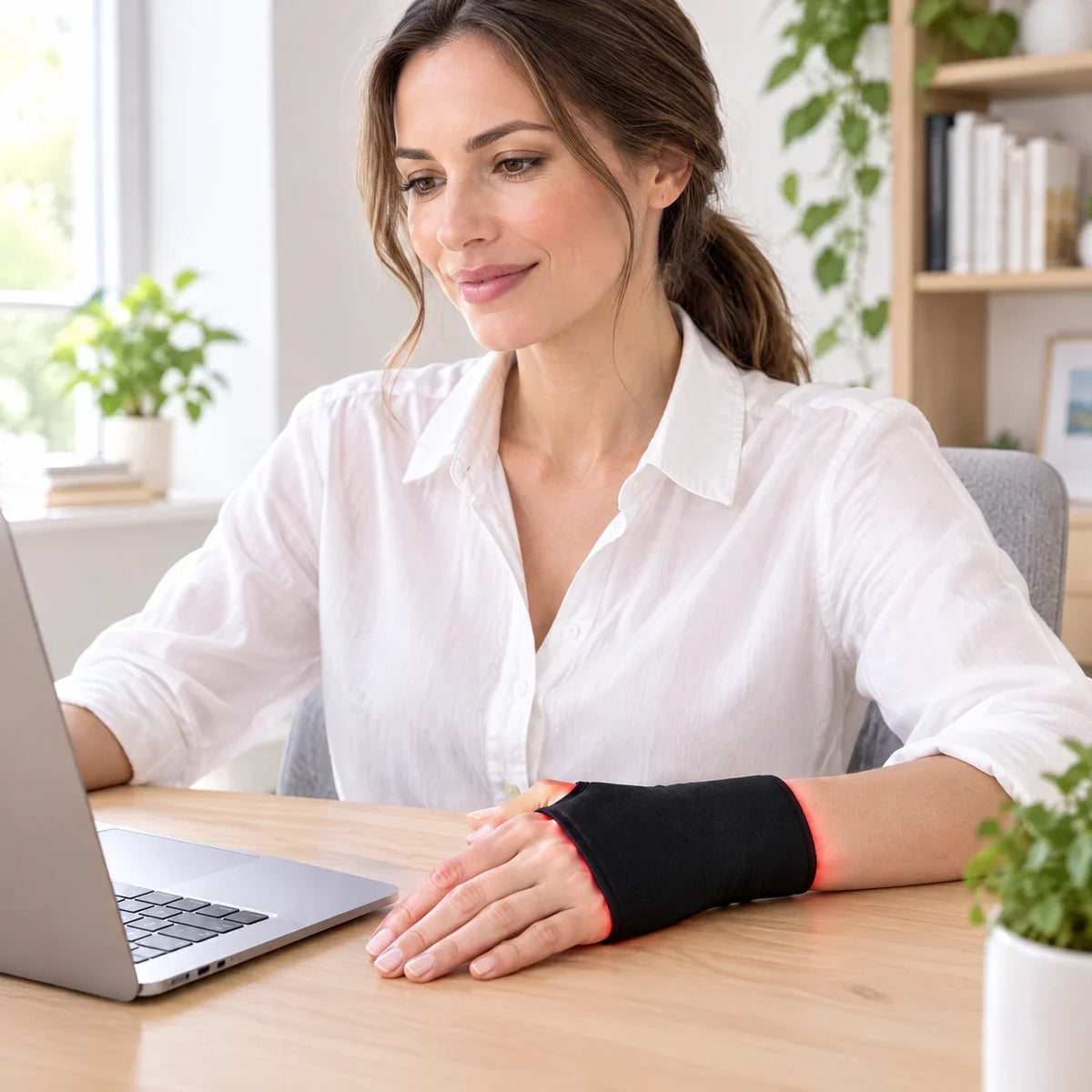
The Lumovex Wrist Strap wraps around the wrist with the LED side against the skin and your thumb through the thumb hole, leaving your fingers free. That is the whole point: you can keep typing, using a mouse or scrolling while a 10-15 minute session runs. It suits desk workers, gamers, phone-heavy users and anyone who lifts and feels it in the wrists afterwards. At £33.99 it is the most affordable way to try red light on a joint. Buy two if both wrists bother you.Not ideal if: your discomfort is mainly in the fingers or knuckles, which the strap does not cover.
Choose the Portable Panel for fingers, knuckles and the back of the hand
The Portable Panel is a compact, hand-held panel with a stated output of 30 mW/cm² at 3 inches. Rest your hand on a table, palm up or palm down, and hold or prop the panel about 3 inches (5-10 cm) away. It covers more of the hand than a strap, so it suits people whose stiffness is in the finger joints, and it moves on to a knee, elbow or shoulder afterwards. The built-in timer switches off at 20 minutes.Not ideal if: you want to work while you use it. It needs a free hand or a prop.
Choose the Pro Panel 540 if it is both hands, or hands plus other joints
The Pro Panel 540 is a standing panel. Sit at a table 15-30 cm from it and lay both hands in front of it, then turn them over halfway through. If your hands are one of several areas you want to cover (knees, lower back, shoulders, face), one larger panel is better value than several small devices. Our knee device guide uses the same logic.Not ideal if: you only care about one wrist and have limited space.
How to use red light on your wrists and hands
- Start with clean, dry skin. Take off watches, rings and bracelets so the light reaches the skin.
- Get the distance right. Wrist Strap: against the skin. Portable Panel: about 3 inches (5-10 cm). Pro Panel 540: 15-30 cm.
- Keep sessions short. 10-15 minutes for the strap, 5-10 minutes per hand for the portable panel. Longer is not better. Our guide to red light therapy dosage, irradiance and joules explains why.
- Cover both sides of the wrist with a panel: palm side, then back of the hand.
- Be consistent. 3-5 sessions a week for 4-6 weeks is a fair trial. Many people find a fixed slot, like the first coffee at the desk, is what makes it stick.
- Pair it with the basics. Stretch, take breaks from the keyboard and look at your desk set-up. Light works alongside good habits, not instead of them.
You do not need goggles with any of these devices. Just do not stare into the LEDs up close, and close your eyes if a panel is near your face.
When to see a GP or physio first
Red light is a comfort and recovery tool. Get your wrist or hand checked before you rely on any device if you have:
- Numbness, tingling or weakness that is getting worse, or wakes you at night
- Swelling, heat or redness in a joint
- Pain after a fall or injury, especially if you cannot grip
- A known condition you are being treated for. Ask whether red light suits your plan.
If you are pregnant, take photosensitising medication or have a condition affected by light, check with a healthcare professional before use.
FAQs
Does red light therapy work for wrist pain?
Research on low-level light for wrist and hand discomfort, including carpal tunnel syndrome and hand arthritis, shows short-term improvements in some small trials, but the evidence is mixed and mostly uses clinical lasers. A home device may help your wrist feel more comfortable as part of a consistent routine. It is not a treatment for a diagnosed condition.What is the best red light therapy device for wrists?
For a single wrist, a wearable wrist strap is the most practical because you can keep working during the session. For fingers and the back of the hand, a compact panel covers more area. For both hands plus other joints, a larger panel is better value.Is a red light wrist wrap the same as an infrared wrist wrap?
Often, yes. Most wraps sold as "infrared" use near-infrared LEDs, and many also include visible red. The Lumovex Wrist Strap uses both 660nm red and 850nm near-infrared. Check the wavelengths listed, because some cheap wraps only use heat or do not state their wavelengths at all.How long should I use red light on my wrist?
10-15 minutes with a wearable strap, or 5-10 minutes per area with a compact panel, 3-5 times a week. Consistency over several weeks matters more than long sessions.Can I use red light therapy on my hands for arthritis?
Many people with hand osteoarthritis or rheumatoid arthritis use red light for comfort, and a Cochrane review found short-term reductions in pain and morning stiffness in rheumatoid arthritis trials. Keep following your treatment plan and check with your GP or rheumatologist first.Can I wear the wrist strap while typing?
Yes. It has an open-finger design with a thumb hole, so you can type, use a mouse or write during a session.Does it get hot?
LED devices may feel gently warm, especially near-infrared, but they should not feel hot. Stop if anything feels uncomfortable.References
- Brosseau L and colleagues. Low level laser therapy (Classes I, II and III) for treating rheumatoid arthritis. Cochrane Database of Systematic Reviews, 2005.
- Burger M and colleagues. The effectiveness of low-level laser therapy on pain, self-reported hand function, and grip strength compared to placebo or "sham" treatment for adults with carpal tunnel syndrome: a systematic review. Physiotherapy Theory and Practice, 2017.
- Bjordal JM and colleagues. A systematic review of low level laser therapy with location-specific doses for pain from chronic joint disorders. Australian Journal of Physiotherapy, 2003.
This article is for general information and is not medical advice. Lumovex devices are CE certified wellness devices and are not intended to diagnose, treat or cure any condition.




Leave a comment
This site is protected by hCaptcha and the hCaptcha Privacy Policy and Terms of Service apply.