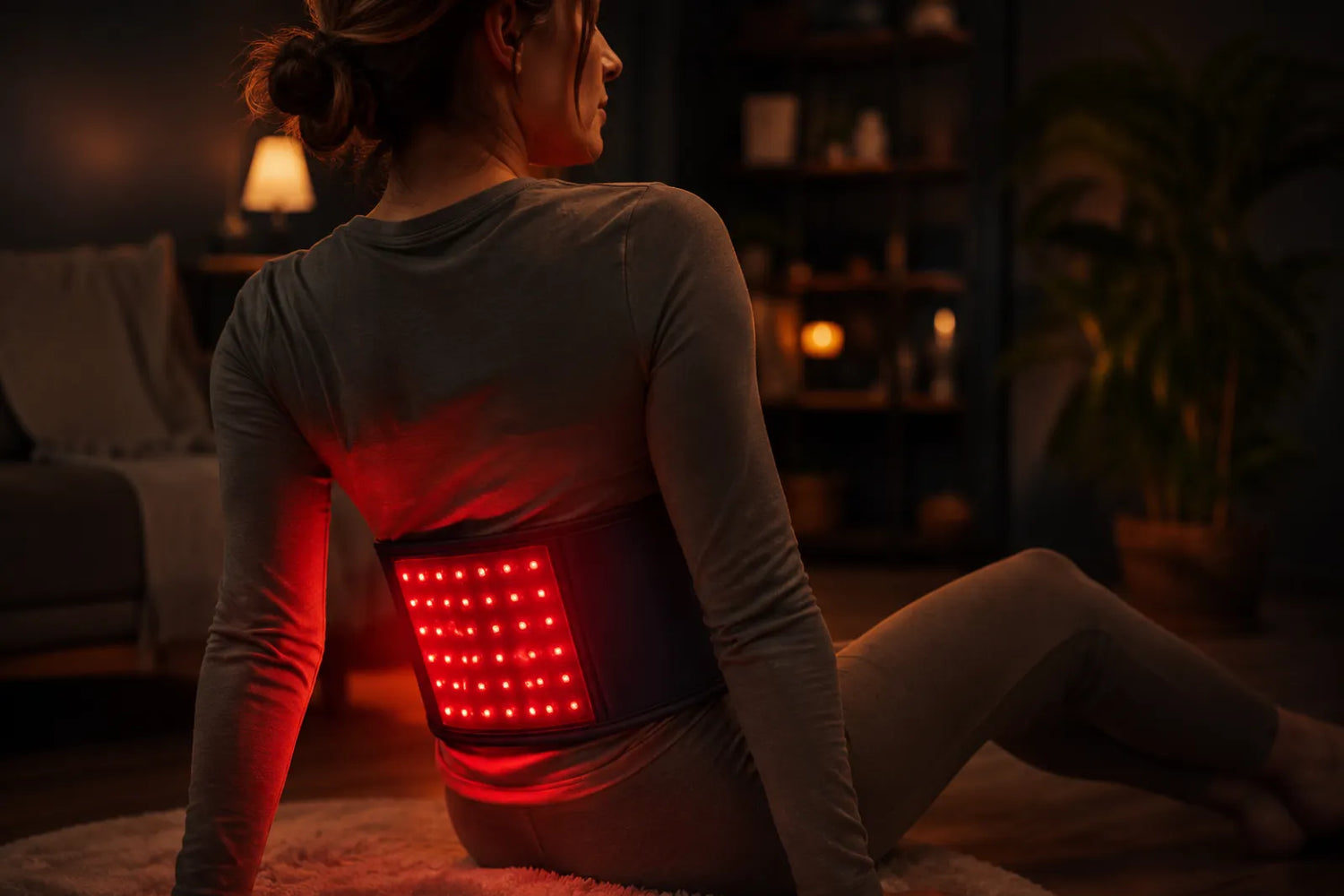
Short answer: for most people, the Lumovex Red Light Therapy Belt (£74.99) is the best fit for the lower back. It wraps round your waist, so it covers your lower back and stomach at the same time, it's hands-free, and it runs from the mains or a USB power bank. Its strength at the skin is published level by level: 89 mW/cm² on level 1 up to 126 mW/cm² on level 5. If you want to lie down and cover the whole length of your back, choose the Total Recovery Mat (£199). If you want the belt and the mat together, the Recovery Kit (£239) is the better-value way to get both.
Below is how the options compare, who each one suits, and an honest look at what the research on light and back pain does and doesn't show.
Lower back devices compared
| Device | Price | What it covers | Hands-free? | Strength (published) | Best for |
|---|---|---|---|---|---|
| Red Light Therapy Belt | £74.99 | Lower back and stomach together, or hips and thighs | Yes, worn | 89-126 mW/cm² at skin contact (L1-L5) | Most people, desk days, sofa sessions |
| Total Recovery Mat | £199 | Neck to ankles when you lie on it | Yes, you lie on top | 11.8-49.3 mW/cm² at the surface (P1-P5) | Whole back plus hips and legs, evening wind-down |
| Pro Panel 540 | £149.99 | Upper or lower back from a distance | Yes, on its stand | Over 150 mW/cm² at 6 inches | Upper back and shoulders, wider-area routines |
| Portable Panel | £99.99 | One small area at a time | No, held or propped | 30 mW/cm² at 3 inches | A single spot, travel |
| Recovery Kit (Belt + Mat) | £239 | Both of the above | Yes | As belt and mat | People who want a daily belt and a weekend mat |
A note on the numbers: belt and mat figures are measured at skin contact, panel figures at a distance, so they aren't directly comparable. What matters is that each figure is published. Many listings give no strength figure at all. Our dosage guide explains how irradiance and session time fit together.
Why the belt suits most lower backs
- It sits where the discomfort is. The belt wraps round your waist, so the LEDs rest against your lower back and stomach together, with 63 red LEDs at 660nm and 42 near-infrared LEDs at 850nm.
- You can carry on with your day. Wear it at your desk, on the sofa or lying back on pillows.
- It isn't tied to a socket. It runs from the mains, or from a USB power bank using the included booster cable.
- It adds vibration massage. Two built-in motors give four massage patterns, which you can use with the light, on their own, or not at all.
- It's the lowest-cost way in. At £74.99 it's the most affordable device in our range for the back.
The trade-off: it covers a band of roughly the lower back, not your upper back or shoulders. For a deeper look at how belts work, see Do red light therapy belts work?
When the mat is the better choice
The mat is 150 x 60cm with 900 LEDs. You lie on top of it with your head on a pillow, and it covers you from the neck to the ankles. That makes it the better pick if your stiffness runs up the whole back, into the hips, or down the legs, or if you'd rather lie down for 15-20 minutes at the end of the day than wear something. It's less portable and you can't use it at a desk. Our red light therapy mat guide goes into more detail.
When a panel makes sense
The Pro Panel 540 stands on a 360-degree rotating base with a height-adjustable arm, so you can angle it at your upper back and shoulders, which a belt can't reach. It's the most flexible option if you also want to use red light on other areas. The trade-off is that you sit or stand in front of it rather than wearing it. The Portable Panel is handy for one small spot, but for a whole lower back it means moving it around, so most people find the belt easier.
What the research on back pain actually shows
Most of the research on light and lower back pain uses low-level lasers in a clinic, not LED belts at home, so it's worth being clear about what it does and doesn't tell us.
- A 2016 meta-analysis by Glazov and colleagues in Acupuncture in Medicine pooled 15 sham-controlled trials with 1,039 people with chronic non-specific low back pain. It found a short-term reduction in pain compared with sham, but only in trials that used higher doses and in people who had had back pain for less than about two and a half years. The authors rated the evidence as moderate quality and called for better-blinded trials.
- A 2015 systematic review by Huang and colleagues in Arthritis Research & Therapy found that pain scores were lower straight after laser treatment than after placebo. The trials were small.
- NICE's guideline on low back pain does not recommend light therapy. It puts staying active, exercise and self-management first.
So the honest picture: there is some evidence that red and near-infrared light may help with short-term comfort, the effects in trials were modest, and home LED devices haven't been tested in the same way. We'd see red light as a comfortable add-on to movement and good habits, not a replacement for them. Researchers think the effect may come from light being absorbed by the mitochondria in cells, which is explained in more detail in our joint pain and stiffness guide.
How to use red light on your lower back
- Use it on clean, bare skin, as clothing blocks most of the light.
- Start on a low level for the first few sessions, then move up if it's comfortable.
- Aim for 10-20 minute sessions, 3-5 times a week. A steady routine matters more than the highest setting. See how often to use red light therapy.
- Pair sessions with gentle movement or stretching where it feels comfortable.
- If your back pain is severe, getting worse, or comes with numbness, weakness or other new symptoms, see your GP before trying anything at home.
Still weighing up other areas too? Our Best Red Light Therapy Devices UK 2026 guide covers every body area.
Frequently Asked Questions
What's the best red light therapy device for lower back pain?
For most people it's a wrap-around belt, because it sits directly on the lower back, it's hands-free and it costs less than a panel or mat. The Lumovex belt is £74.99, with published strength of 89-126 mW/cm² at skin contact. Choose a mat instead if you want to cover the whole back, hips and legs while lying down.
Can I wear the belt at my desk?
Yes. It stays in place on its own, so you can wear it while you work, watch TV or lie back on the sofa. It needs to sit against bare skin, so wear it under a loose top rather than over clothing.
Belt or mat for back and hips?
If it's mainly the lower back, the belt. If it runs from the lower back into the hips and legs, the mat, because you lie on it and it covers you from neck to ankles. Plenty of people use both, which is what the Recovery Kit (£239) is for.
Is there a cheaper option than a panel?
Yes. The belt is £74.99, which is cheaper than the Pro Panel 540 (£149.99) or the Portable Panel (£99.99), and for the lower back it's usually the more practical choice too.
Does the belt heat up?
It runs warm against the skin but it isn't a heat pad. If it ever feels too warm, drop down a level.
How long before I notice anything?
Some people find sessions relaxing straight away. In the trials above, changes in comfort were measured over a few weeks of regular sessions, and many people give it 4-6 weeks of consistent use before judging it. Results vary.
Will red light fix the cause of my back pain?
No. It won't change a disc problem, posture or how strong your back muscles are. Movement, strengthening and a good desk set-up do that. Red light is something you can add alongside them.
The bottom line
For most lower backs, start with the belt: it's targeted, hands-free and £74.99. Go for the mat if you want to cover your whole back, hips and legs lying down, and the Pro Panel 540 if the upper back and shoulders matter more. Whatever you choose, use it alongside movement, and see your GP if your pain is severe or changing.
Disclaimer: Lumovex devices are wellness products, not medical devices. They are not intended to diagnose, treat, cure or prevent any disease. Speak to a healthcare professional about persistent or severe pain.


Leave a comment
This site is protected by hCaptcha and the hCaptcha Privacy Policy and Terms of Service apply.