

If you have looked into red light therapy at home, you have probably seen three formats: masks for the face, panels you stand or sit in front of, and mats you lie down on. The mat is the one people understand least, and it is often the one that suits a busy routine best.
This guide explains what a red light therapy mat actually is, how it works, what it covers, and who it is a good fit for. No hype, no medical promises, just the honest version so you can decide whether a mat belongs in your routine.
What a red light therapy mat is
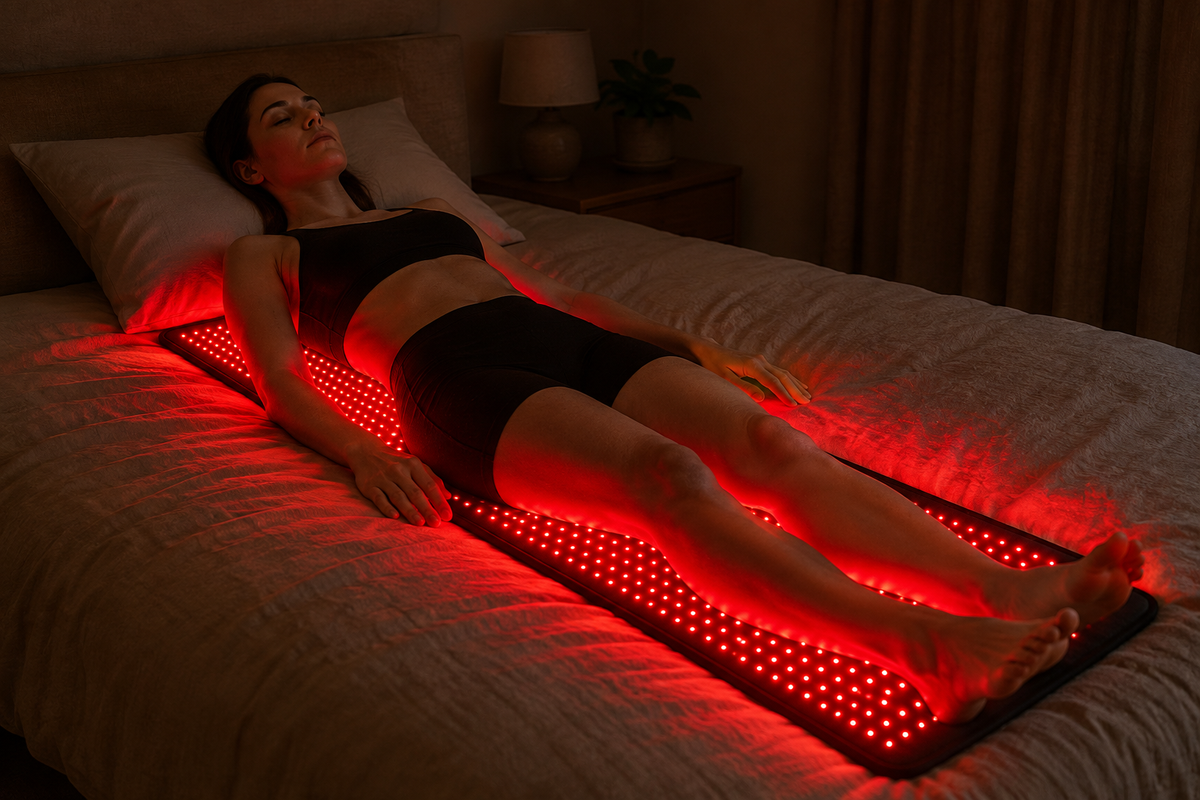
A red light therapy mat is a flexible, roll-out surface lined with LEDs that you lie down on. Instead of sitting in front of a rigid panel or wearing a device, you roll the mat out on a bed, sofa or floor, lie back, and let the light do its thing for around 15 to 20 minutes.
The appeal is simple: it is hands-free and passive. You are not holding anything, standing in position, or blocking out extra time in your day. You lie down, which most people are happy to do anyway in the evening.
The Lumovex Total Recovery Mat is a good example of the format: a roll-out red light therapy mat with a controller, mains-powered, designed for lying-down sessions on whatever flat surface suits you.
How a red light therapy mat works
Red light therapy, also called photobiomodulation, uses specific wavelengths of light that are absorbed by the skin and the tissue beneath it. The idea, supported by a growing body of research, is that this light energy is taken up by the mitochondria in your cells and may support the body's own recovery and repair processes.
Most quality mats, including the Lumovex mat, use two wavelengths together:
- 660nm red light, which is absorbed closer to the skin's surface
- 850nm near-infrared light, which is designed to reach deeper into muscle and connective tissue
Pairing the two means one session covers both the surface and the deeper layers. It is worth being clear on expectations here: red light therapy is a consistency tool, not an overnight fix. Studies suggest the benefits build gradually with regular use over weeks, rather than appearing after a single long session.
What a mat actually covers
This is where honesty matters, because the word "full-body" gets thrown around loosely.
A mat covers a large, continuous area in one go. The Lumovex mat is 150 x 60cm, so lying on it reaches from roughly your neck to your ankles, depending on your height and how you lie. That takes in the areas most people care about for recovery and relaxation: your back, shoulders, hips, glutes, hamstrings and calves, in a single session.
What it does not do is treat both sides of you at once. The light reaches the side of your body resting on the mat, so to cover your front you would turn over for a second session. It also will not reach your head or feet. If your priority is one specific spot, such as a knee or your face, a targeted device is a better tool. For most people focused on the large muscle groups and a relaxing wind-down, a single lie-down session does the job.
Mat vs panel vs mask: which format suits you
Each format is built for a different job. None is "better" in the abstract, they simply suit different routines.
- Mat. Passive, lie-down, large-area coverage. Best if you want hands-free sessions and would rather relax than stand still. Ideal for recovery and evening wind-down.
- Panel. Targeted and upright. The Lumovex Pro Panel 540 is designed for standing or seated sessions where you point the light at a specific area, a shoulder, knee or lower back, at a chosen distance.
- Mask. Face-focused. The Lumovex Spectrum Pro Mask is shaped to the face for skin-focused sessions and is not a body device.
Plenty of people end up using more than one. A common pairing is a mat for large-area recovery on rest days and a panel for targeted work on training days. If your interest is hands-free lower-back or core recovery specifically, the Lumovex Red Light Therapy Belt is a lower-cost way to cover that one area.
Who a red light therapy mat is for
A mat tends to suit:
- People building a recovery routine. Athletes and regular gym-goers who want hands-free coverage of the large muscle groups after training.
- Busy schedules. If the only slack in your day is rest time, a mat fits into it. You are lying down anyway.
- Evening wind-down. Many people use it as part of a calming end-of-day routine rather than an active "treatment".
- Anyone who dislikes standing panels. If holding a position in front of a panel feels like a chore, lying down removes that friction entirely.
What a mat may help with
Keeping this honest and within what the evidence supports, regular use of a red light therapy mat may help with:
- Supporting post-training muscle recovery
- The general feel of joint and muscle comfort
- A calmer, more consistent evening wind-down routine
Red light therapy is not a treatment for any medical condition, and results vary from person to person. It works best as a steady habit layered into your routine, not as a quick fix.
How to use a red light therapy mat
- Roll the mat out on a flat surface, a bed, sofa or floor.
- Lie down comfortably with the LED side toward your body. For best results, use it on bare skin so the light reaches you directly.
- Run a session of 15 to 20 minutes.
- Use it 3 to 5 times a week, consistently. A steady rhythm delivers better results than the occasional long session.
What to look for when buying a mat
If you are comparing mats, these are the things that actually matter:
- Wavelengths. Look for both red (around 660nm) and near-infrared (around 850nm). A dual-wavelength mat covers both surface and deeper tissue.
- Coverage area. Check how much of the body the mat treats in one session, and be realistic about the head-to-toe claims.
- Warranty and support. A UK-based warranty and support line matters if anything goes wrong. The Lumovex mat comes with a 2-year warranty, 30-day returns and UK-based support.
- Certification. Look for CE Certified.
- Price versus clinic sessions. A one-off home device removes travel, booking and repeat session fees. Clinic-style full-body LED sessions add up quickly by comparison.
Frequently asked questions
How long should a red light therapy mat session be?
Most people use 15 to 20 minute sessions. Longer is not better, consistency matters more than duration. A regular routine tends to outperform occasional long sessions.
How often can I use a red light therapy mat?
Around 3 to 5 times a week is a common rhythm. It is designed to be used regularly as part of a routine.
Is a mat better than a panel?
Neither is better overall, they do different jobs. A mat is passive, lie-down and covers a large area. A panel is upright and targeted. Many people use both for different days.
Does a red light therapy mat help with back pain?
A mat may help support general muscle and joint comfort across the back and torso, which is one of the most common reasons people choose the format. It is not a treatment for a medical condition, so if you have persistent pain, speak to a healthcare professional.
Can I use it through clothing?
For best results, use it on bare skin so the light reaches your body directly. Thin clothing works in a pinch, but skin contact is recommended.
How long until I notice a difference?
Red light therapy is a gradual support tool. Many people notice changes within 4 to 8 weeks of consistent use, such as muscles that feel more comfortable after training or an easier evening wind-down. Results vary by individual.
Ready to build a hands-free recovery routine? Explore the Lumovex Total Recovery Mat, with free UK mainland delivery, a 30-day return window and 2-year warranty.




Leave a comment
This site is protected by hCaptcha and the hCaptcha Privacy Policy and Terms of Service apply.