

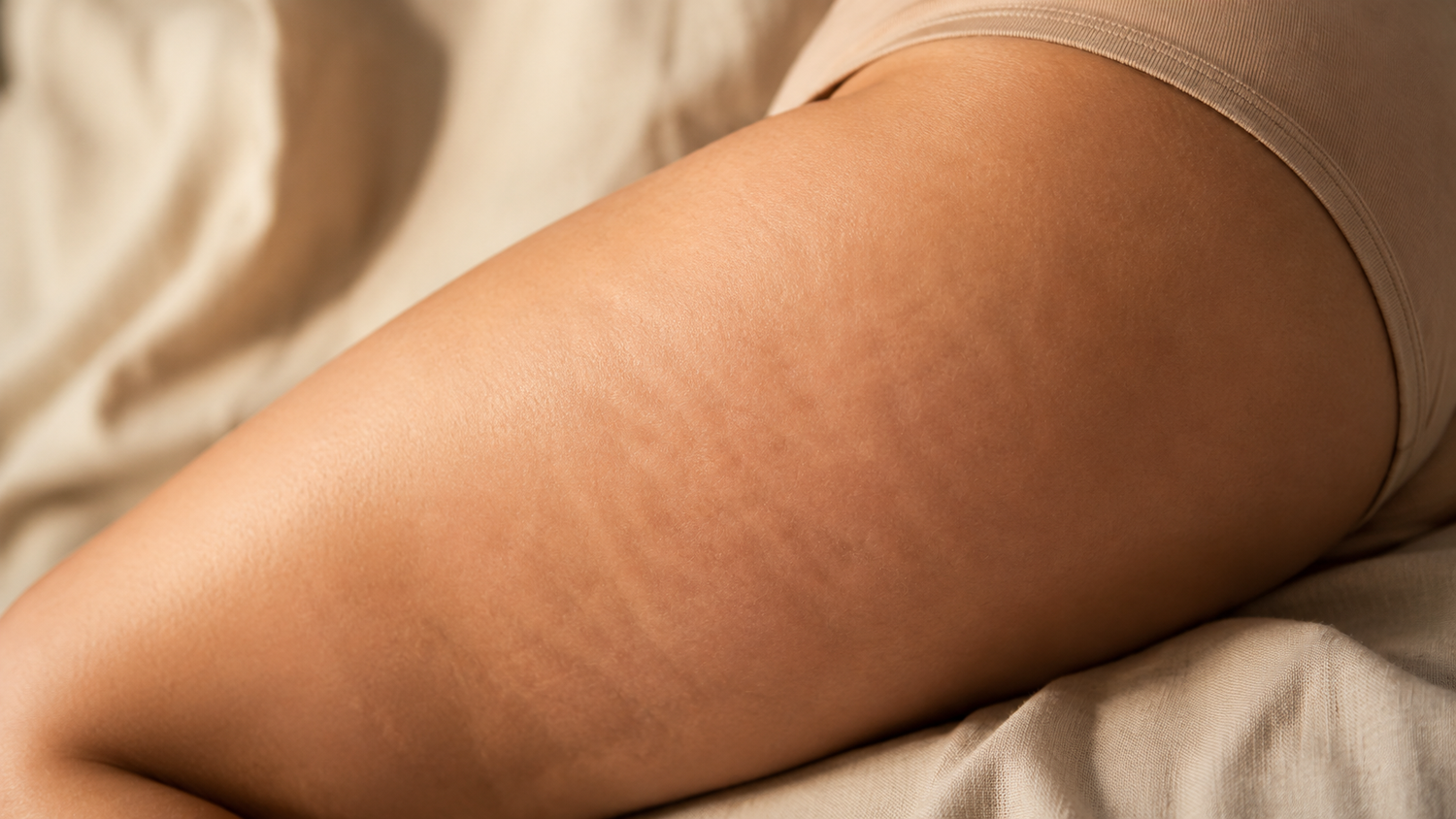
Cellulite is normal. Between 85 and 90 percent of women have visible cellulite on the thighs, hips or glutes by their late twenties, and the £8 billion global cellulite industry has spent decades selling creams, wraps and brushes that quietly underdeliver.
Red light therapy is different. It is one of the few non-invasive options with peer-reviewed research behind it. It is not a miracle, and anyone telling you otherwise is selling you something. But used consistently and combined with movement, it is one of the most credible at-home tools available right now.
Here is what the science actually says, what to realistically expect, and which Lumovex device fits the area you want to target.
What Cellulite Actually Is
Cellulite is a structural issue, not just stored fat. Underneath the skin, fibrous bands called septae anchor the skin to deeper muscle tissue. Between those bands sit fat lobules. As the septae tighten or thicken with age and the fat lobules push upward, the surface of the skin develops the characteristic dimpled or quilted appearance.
Dermatologists grade cellulite on the Nürnberger-Müller scale, from Stage 0 (no visible dimpling, even when pinched) to Stage 3 (visible at rest, even when standing).
Because cellulite is partly structural, diet and exercise alone often fail to fix it. You can get leaner without your cellulite changing much, because the underlying septae and skin texture have not been addressed. That is why topical creams that only hydrate the skin produce mild, temporary improvements at best.
How Red Light Therapy Targets Cellulite
Red light therapy uses red and near-infrared wavelengths to reach different layers of skin and underlying tissue. There are three relevant mechanisms:
1. Lipolysis (fat cell shrinkage). Research suggests that red and near-infrared light can stimulate transient pore formation in fat cells (adipocytes), allowing stored triglycerides to release into the bloodstream where they can be metabolised through normal activity. This effect is modest on its own and meaningfully larger when combined with exercise.
2. Collagen remodeling. Red light therapy is one of the better-evidenced tools for stimulating collagen production in the dermis. Stronger, denser collagen helps the surface skin appear smoother and reduces the visibility of the septae underneath.
3. Microcirculation and lymphatic drainage. Red light improves blood flow and supports lymphatic drainage in the treatment area, which may reduce localised fluid retention that can amplify the appearance of dimpling.
These mechanisms work together rather than independently. The visible improvement people see over weeks of consistent use is the combined effect of slightly smaller fat cells, stronger surface skin, and better drainage.
What the Research Shows
The evidence base on red light therapy for cellulite is small but consistent.
- Caruso-Davis and colleagues (2011), Obesity Surgery. A double-blinded, randomised trial of 635nm low-level laser on the waistline. Forty adults received eight 30-minute sessions over four weeks. The treated group lost an average of 2.15cm in waist circumference compared to the control group, with the proposed mechanism a transient release of triglycerides from fat cells without damaging them. This is body-contouring evidence rather than cellulite-specific evidence, but it underpins the lipolysis mechanism described above. Read on PubMed.
- Paolillo and colleagues (2011), Journal of Cosmetic and Laser Therapy. Twenty women aged 25 to 55 trained on a treadmill twice a week for three months at 85 to 90 percent of maximal heart rate. Half had infrared LED (850nm) applied during their sessions, half did not. The LED group showed reduced thigh and saddlebag circumference and improved body composition compared to exercise alone. This is the strongest direct evidence that light plus movement beats either on its own for cellulite-affected areas. Read on PubMed.
- A 2018 systematic review by Jagdeo and colleagues, Lasers in Surgery and Medicine. Pulled together 31 randomised controlled trials of LED therapy across dermatology. Its honest conclusion on cellulite: LED used on its own produces only limited improvement, and the evidence quality is lower than for conditions like acne or wound healing. The cellulite trials that did show meaningful improvement tended to combine LED with another modality, most commonly exercise or a topical agent. Read on PubMed.
The honest summary: red light therapy on its own produces a noticeable but modest improvement in skin appearance. Red light therapy plus regular movement produces the visible results most people are actually hoping for.
Realistic Timeline and Expectations
If you start using red light therapy on a target area four to five times per week, here is roughly what to expect:
- Weeks 1 to 4: Skin texture and tone improve. Treated areas often feel softer and look slightly smoother. Visible dimpling has usually not changed yet.
- Weeks 4 to 8: The cottage-cheese pattern begins to soften. Photographs taken in the same lighting start to show real differences.
- Weeks 8 to 12: This is where most people see their best results, particularly if they have paired sessions with lower-body movement.
- Maintenance: Two to three sessions per week is usually enough to hold gains.
The single biggest reason people fail to see results is inconsistency. Three sessions a week for two weeks then nothing for ten days will not produce visible change. Four short sessions a week for three months will.
Which Lumovex Device for Cellulite
The right device depends on which area you want to target.
| Device | Best for | How to use | Frequency |
|---|---|---|---|
| Red Light Therapy Belt | One thigh, hip or lower abdomen | Wraps directly around the target zone | 15 to 20 minutes, 4 to 5 times per week |
| Pro Panel 540 | Both thighs, glutes, full lower body | Stand or sit in front of the panel | 12 to 15 minutes, 4 to 5 times per week |
| Lumovex Recovery Mat | Back of legs and glutes lying down | Lie face-down on the mat | 15 to 20 minutes, 4 to 5 times per week |
Quick recommendation:
- One target area (e.g. one thigh) and a smaller budget: the Belt.
- Both thighs, both glutes, time-poor and standing-friendly: the Panel.
- Whole-body wellness with cellulite as one of several goals: the Mat.
If you are unsure, our full-body vs targeted red light therapy guide walks through the trade-offs in more detail.
How to Maximise Results
A few small habits make a meaningful difference:
- Move. Lower-body strength work (squats, lunges, hip thrusts) two to three times per week amplifies results more than any topical product.
- Hydrate. Lymphatic drainage works better when you are properly hydrated.
- Be consistent. Four 15-minute sessions per week beats one 60-minute session.
- Treat clean, dry, exposed skin. Lotion, leggings or shapewear all reduce light penetration.
- Optional: dry brush before sessions. It boosts circulation and is a low-cost addition that pairs well.
Who Should Avoid Red Light Therapy on Cellulite Areas
Red light therapy is generally very safe, but some people should pause or check with their GP first:
- Pregnancy (no harm shown but limited research, so we recommend caution)
- Active skin infections in the target area
- Photosensitising medications such as some antibiotics, isotretinoin or St John's Wort
- Recent dermal fillers or cosmetic injections in the area (wait two weeks)
FAQ
Does red light therapy really work for cellulite?
Clinical research suggests it produces modest improvements when used alone and meaningfully better results when combined with regular movement. It is not a miracle, but it is one of the few at-home options with credible peer-reviewed evidence.
How long does it take to see results from red light therapy on thighs?
Most people see skin texture and tone improvements within 2 to 4 weeks. Visible reduction in dimpling tends to appear between weeks 4 and 8, with the most noticeable change at the 8 to 12 week mark.
Can red light therapy replace dry brushing or massage?
It does not need to. Dry brushing pre-session and gentle massage can complement red light therapy by supporting circulation and lymphatic drainage. They work well together.
Is red light therapy better than radio frequency for cellulite?
They work via different mechanisms. Radio frequency uses heat to tighten skin, red light uses light to support cellular function and collagen. Red light is gentler, more affordable for at-home use, and has no recovery time.
How often should I use red light therapy for cellulite?
Four to five sessions per week of 15 to 20 minutes per area for the first 8 to 12 weeks. Once you reach your target appearance, two to three sessions per week is usually enough to maintain.
Will cellulite come back if I stop using red light therapy?
Results from collagen remodeling are relatively durable, but if you stop completely the gradual changes from ageing, hormones and weight fluctuations will continue. Most people maintain results with two to three sessions per week long term.
The Bottom Line
Red light therapy is not magic and it is not a substitute for movement. What it is, is one of the few at-home tools with actual peer-reviewed evidence for improving the appearance of cellulite. Used consistently for 8 to 12 weeks alongside regular lower-body movement, it produces real, visible improvements in skin texture and dimpling.
If you want to start, the Belt is the most affordable entry point for a single target zone. The Pro Panel 540 is the better choice if you want to treat both legs at once, and the Recovery Mat covers the full posterior chain lying down.
Not medical advice. Consult a GP if you have concerns about skin conditions or if you are taking medication that increases photosensitivity.


Leave a comment
This site is protected by hCaptcha and the hCaptcha Privacy Policy and Terms of Service apply.