

Last updated: June 2026 · Written by the Lumovex team · 12 min read
The short answer
Red light therapy at home in the UK uses LED devices that emit specific red (around 660nm) and near-infrared (around 850nm) wavelengths, which research suggests may help support skin condition, recovery, and general wellbeing when used consistently. The five main device types are LED face masks, panels, mats, belts, and handheld wands, each suited to different goals. For most UK buyers in 2026, a quality at-home device sits in the £100 to £400 range and is used for 10 to 20 minutes per session, three to five times per week. Below is the complete buyer's guide.
What is red light therapy?
Red light therapy (RLT), also known as photobiomodulation or low-level light therapy, is a non-invasive treatment that uses specific wavelengths of red and near-infrared light. Unlike sunlight, these LED devices do not emit UV rays, so there is no associated UV damage.
The therapy has been studied for several decades, originally in clinical and dermatology settings. Over the last few years, advances in LED efficiency and falling costs have brought clinic-style devices into the home, with at-home options now available across face, body, and targeted-recovery formats.
How red light therapy works
The proposed mechanism is straightforward in principle. When red and near-infrared light is absorbed by skin and tissue, research suggests it may help support how cells produce and use energy. This is thought to be the basis for the reported effects on skin appearance, post-exercise recovery, and general comfort. Individual responses vary, and consistent use over weeks tends to produce more noticeable results than occasional sessions.
Red vs near-infrared: the two wavelengths to know
Most quality at-home devices combine two wavelengths, red light (typically around 660nm) and near-infrared (typically around 850nm). They behave differently, which is why combination devices are common.
| Wavelength | How it behaves | Most associated with |
|---|---|---|
| Red light (~660nm) | Absorbed closer to the skin surface | Skin appearance, fine lines, overall complexion |
| Near-infrared (~850nm) | Travels deeper into tissue | Muscle and joint comfort, post-exercise recovery |
Some entry-level devices use only red light, which is fine for skin-focused goals but more limited if you also want body recovery benefits. Dual-wavelength devices give you both depths in one session, which is why most of our range, including the Spectrum Pro Mask and Pro Panel 540, combines the two.
What can red light therapy help with?
Research suggests red light therapy may help support a range of common goals. The evidence is stronger in some areas than others, and the language below reflects what the research currently indicates rather than guarantees.
- Skin appearance: Studies indicate red light may help support the appearance of fine lines, skin tone, and overall radiance with consistent use.
- Post-exercise recovery: Near-infrared wavelengths have been studied for their potential to support the body's natural recovery process after training.
- Muscle and joint comfort: Deeper-penetrating wavelengths may help support comfort in areas that take repeated load, such as knees, lower back, and shoulders.
- Sensitive skin and redness: Regular sessions may help support overall skin comfort.
- Targeted concerns: Localised devices like wands and wrist straps allow you to focus light on specific areas.
Users often report more noticeable benefits after four to eight weeks of consistent use, rather than from one-off sessions. Red light therapy is best thought of as a routine, not a treatment.
The five types of at-home red light therapy devices
Choosing the right format is the single most important decision. Each type is built for a specific use case, and matching the device to your goal matters more than chasing higher LED counts or wattage.
| Device type | Best for | Typical session | UK price range (2026) |
|---|---|---|---|
| LED face mask | Skin appearance, anti-ageing routine | 10 min, hands-free | £100 to £400 |
| Red light panel | Full-body skin and recovery | 10 to 15 min, standing or seated | £100 to £600 |
| Recovery mat | Lying-down full-body sessions | 15 to 20 min | £120 to £350 |
| Therapy belt | Targeted muscle and joint areas | 10 to 20 min, wearable | £70 to £200 |
| Wand or wrist strap | Spot treatment, specific points | 3 to 10 min per area | £20 to £80 |
1. LED face masks
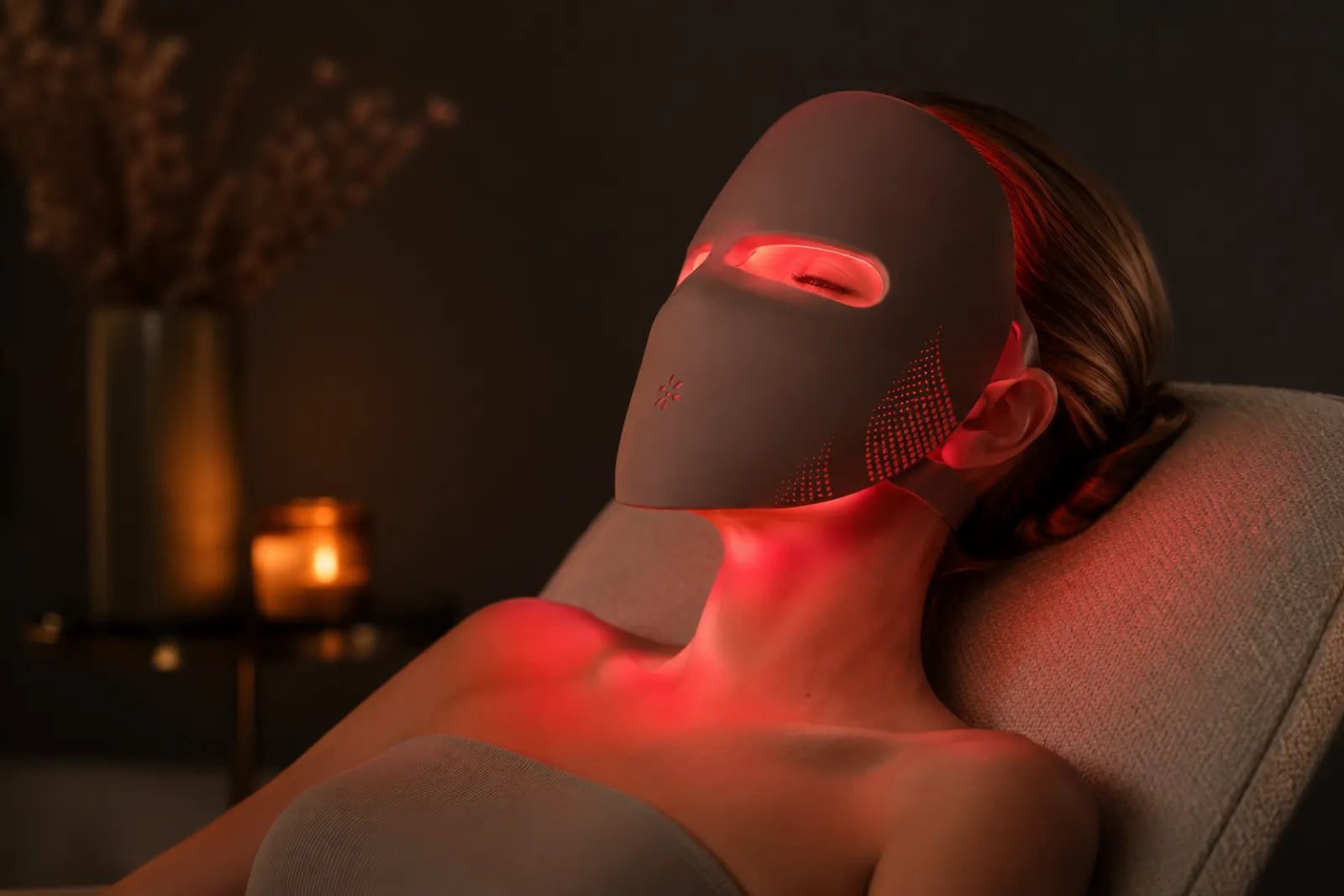
Face masks are the most popular entry point for red light therapy in the UK, and for good reason. They are hands-free, take 10 minutes, and slot into an existing skincare routine without changing it. A quality LED mask combines red light for skin appearance with near-infrared for deeper support, and sits comfortably on the face for the session length.
For skin-focused users, the Lumovex Spectrum Pro Mask covers the full face with dual wavelengths at £149.99, a noticeably lower price point than the more recognised brands at this performance level. If neck appearance is also a priority, the Mask + Neck bundle at £194.99 covers both areas in a single session, which most competitor sets price closer to £600 once combined.
The neck point matters more than people expect. The skin on the neck shows ageing earlier than the face, and most face-only routines leave it out entirely.
2. Red light panels
Panels are the most versatile option. A good panel can be used for face, decolletage, back, knees, shoulders, or full body, depending on distance and positioning. They are best for buyers who want one device that covers multiple goals, or who are training and want a recovery tool alongside their skin routine.
The Lumovex Pro Panel 540 is the workhorse option in our range at £149.99, combining red and near-infrared in a panel designed for at-home use rather than a converted commercial unit. For smaller spaces or travel, the Portable Panel at £99.99 covers focused areas like the face or a knee.
Panel sessions are typically 10 to 15 minutes at a hand-distance of about 15 to 30 cm, three to five times a week.
3. Red light therapy mats
Mats are the lying-down option. You roll them out, lie on or under them, and let the light work across the back, glutes, hamstrings, and calves in one session. They are particularly popular with people who train, because they let you target the recovery-priority areas (lower back, posterior chain) hands-free while you rest.
The Lumovex Total Recovery Mat at £126.99 is built for this, full-body coverage in a flat session, with dual wavelengths so you get both skin-surface and deeper-tissue exposure. We saw the first repeat customer in our history this month buy a Pro Panel for face and decolletage, then come back six days later for two recovery mats, a clean example of how panels and mats stack rather than compete.
4. Red light therapy belts
Belts are the targeted format. They wrap around a specific area, typically lower back, waist, knees, or shoulders, and let you wear the device during a session rather than positioning yourself in front of it. The session is usually 10 to 20 minutes.
The Lumovex Red Light Therapy Belt at £74.99 is the lowest-friction product in the category and one of the most popular for buyers whose main goal is muscle and joint comfort rather than skin appearance.
5. Wands and wrist straps
Wands and wrist straps are the targeted spot-treatment formats. They suit people who want to focus light on a small area, a specific blemish, a single joint, or a defined point, rather than a broad surface.
The Lumovex Sculpt Wand at £20.99 is a low-cost entry point for people who want to try the category before committing to a larger device, or who already have a panel and want a focused tool for specific points.
How to choose the right device
The right device depends almost entirely on what you actually want to do with it. The questions below cut through most of the noise.
- What is your main goal? Skin appearance points to a mask or panel. Body recovery points to a mat, belt, or panel.
- Do you want hands-free or wearable? Masks, mats, and belts are hands-free or wearable. Panels and wands require positioning.
- How much space do you have? Mats and panels need floor or wall space. Masks and belts do not.
- Do you want one device or a routine of two? A mask plus a belt covers face and body for under £225 combined and is often the best value entry point.
- Are you replacing salon sessions or supplementing them? Replacing a salon habit usually justifies a higher-spec device like a full-coverage panel or mat. Supplementing existing care often points to a mask or wand.
How often should you use red light therapy?
The honest answer is that consistency matters more than session length. Most studies that show benefit use sessions of 10 to 20 minutes, three to five times per week, for at least four to eight weeks before measuring outcomes.
| Goal | Session length | Frequency | Time to noticeable change |
|---|---|---|---|
| Skin appearance | 10 min | 4 to 5 times per week | 4 to 8 weeks |
| Post-training recovery | 15 to 20 min | After training sessions | 2 to 4 weeks |
| Targeted comfort | 10 to 15 min per area | Daily or as needed | 2 to 6 weeks |
| General wellbeing | 10 to 15 min | 3 to 5 times per week | 4 to 8 weeks |
Doing a longer session once a week is generally less effective than shorter, more frequent ones. The biggest predictor of outcome in user reports is whether the device actually gets used. Hands-free formats (masks, mats, belts) tend to have higher real-world compliance than ones that need active positioning.
Are at-home devices as effective as in-clinic treatments?
This is one of the most asked questions in the category. The short answer is: it depends on what you are comparing.
Clinic-grade devices used in professional settings often have higher output and are operated by trained staff, which can produce results in fewer sessions. At-home devices have lower per-session intensity by design (for safety and unsupervised use), but make up for it through frequency. A clinic session twice a month is not necessarily more effective than 15 daily home sessions across the same period.
The honest comparison is on long-term outcome, not single-session intensity. For users who can commit to a consistent at-home routine, a quality dual-wavelength device may close most of the gap with salon sessions at a fraction of the lifetime cost.
Is red light therapy safe?
Red light therapy is generally considered safe for most users when used as directed. LED devices do not emit UV, so there is no associated UV damage. The most important safety points are:
- Eye protection. Use the goggles supplied with your device, or close your eyes if no goggles are included. Direct bright LED light is uncomfortable even where it is not harmful.
- Light-sensitive medication. If you take medication that increases light sensitivity (some antibiotics, certain skin treatments), check with a healthcare professional before starting a routine.
- Pregnancy. If you are pregnant or trying to conceive, speak to a healthcare professional before using full-body devices.
- Active skin conditions. If you have an active skin condition or are unsure, get advice from a dermatologist before starting.
Quality at-home devices in the UK should hold CE certification and be tested to the relevant standards. All Lumovex devices are CE certified and UK tested.
Common myths about red light therapy
Myth 1: More LEDs always means a better device. LED count is one input, not the whole story. Wavelength accuracy, beam angle, irradiance at usage distance, and build quality all matter. A well-designed 150 LED device can outperform a cheaper 300 LED one.
Myth 2: You need a £600 device to get results. The premium price points in this category reflect brand premium, not always performance premium. Quality dual-wavelength devices at the £100 to £200 range can match the at-home performance of the most recognised premium brands.
Myth 3: You will see results after one session. Red light therapy is a routine, not a treatment. Most studies measure outcomes over four to eight weeks of consistent use. Expect gradual change, not overnight transformation.
Myth 4: All wavelengths are the same. They are not. Red light around 660nm and near-infrared around 850nm behave differently in the body. Cheaper devices using less precise wavelengths (such as 630nm) may be less well-aligned with the published research.
Myth 5: You can use red light therapy with any skincare. Most skincare is fine, but some active ingredients (certain retinols, exfoliants) can increase short-term sensitivity. A clean, dry face during the session is usually the safest default.
Red light therapy in the UK: what's changed in 2026
The UK market has moved quickly in the last 18 months. A few things worth knowing if you are buying this year:
- Pricing has compressed. Quality dual-wavelength devices that were £300 plus two years ago now sit in the £100 to £200 range.
- Buy-now-pay-later is now standard. Most reputable UK red light therapy brands now offer Klarna or similar at checkout.
- Hybrid devices are emerging. Some new devices combine LED light with cooling or massage features. These can be useful but are not necessary for the light therapy itself.
- Spec-war marketing is louder. Some brands lead with LED count or wattage. The underlying clinical research is based on dose at the skin, not raw LED count, so do not over-index on those numbers.
Frequently asked questions
How long does it take to see results from red light therapy at home?
Most users start to notice changes after four to eight weeks of consistent use, three to five times per week. Recovery-focused use (such as after training) can show benefits within two to four weeks. Single sessions are unlikely to produce visible change.
Is red light therapy safe to use every day?
For most users, yes. Sessions of 10 to 20 minutes can be used daily on most areas. Avoid stacking multiple long sessions on the same area in a single day, and follow the manufacturer's guidance for your specific device.
Can I do red light therapy through clothing?
Light works best on bare skin. Belts and mats can be used over thin clothing if needed, but bare-skin contact gives the most consistent exposure.
What wavelengths should I look for in an at-home device?
For combined skin and recovery goals, look for a device that uses both red light around 660nm and near-infrared around 850nm. Skin-only goals can be met by 660nm alone, but dual-wavelength devices give you more flexibility.
Do I need eye protection?
Use goggles where the manufacturer supplies them. Closing your eyes is generally enough for face masks designed for direct facial use, but check the guidance for your specific device.
Can red light therapy help with menopausal skin changes?
Research suggests red light therapy may help support skin appearance in users navigating hormonal changes, including perimenopause and menopause. Consistency matters more than intensity for this group, which makes hands-free formats like masks particularly suitable.
Is it worth buying a panel and a mask, or just one?
For most users, one well-chosen device is enough to start. People with both skin and recovery goals often add a second device after the first one is part of their routine. Mask plus belt is the most common combination and the most cost-effective full-coverage entry point.
How much electricity do these devices use?
Typical at-home LED devices use 30 to 200 watts during a session. A 15-minute session of even a higher-power panel uses a small amount of electricity, similar to running a hair dryer briefly.
What is the difference between red light therapy and infrared saunas?
Infrared saunas use far-infrared heat for whole-body warming and sweating. Red light therapy devices use specific red and near-infrared wavelengths at much lower intensity, without significant heat. The two are different protocols with different goals.
Where can I buy red light therapy devices in the UK?
Lumovex devices are available directly at lumovex.co.uk with free UK delivery, a 30 day return window, and a 1 year warranty. Klarna is available at checkout.
The bottom line
Red light therapy at home in 2026 is more accessible than at any previous point. The science is increasingly well-understood, the device costs have come down, and the format choice has widened. The honest summary is this: pick the device type that matches the goal you actually have, commit to consistent sessions for at least eight weeks, and judge the outcome on the long-term rather than the first week. The most expensive device on the market is not always the right one, and the cheapest is not always the wrong one. Match the format to the goal, and the rest tends to follow.
If you would like a single starting point, the Spectrum Pro Mask at £149.99 is the lowest-friction entry into skin-focused use. For body and recovery, the Red Light Therapy Belt at £74.99 is the lowest-friction entry into targeted use. Either is a sensible first device, and both have a 30 day return window if it is not the right fit.


Leave a comment
This site is protected by hCaptcha and the hCaptcha Privacy Policy and Terms of Service apply.