

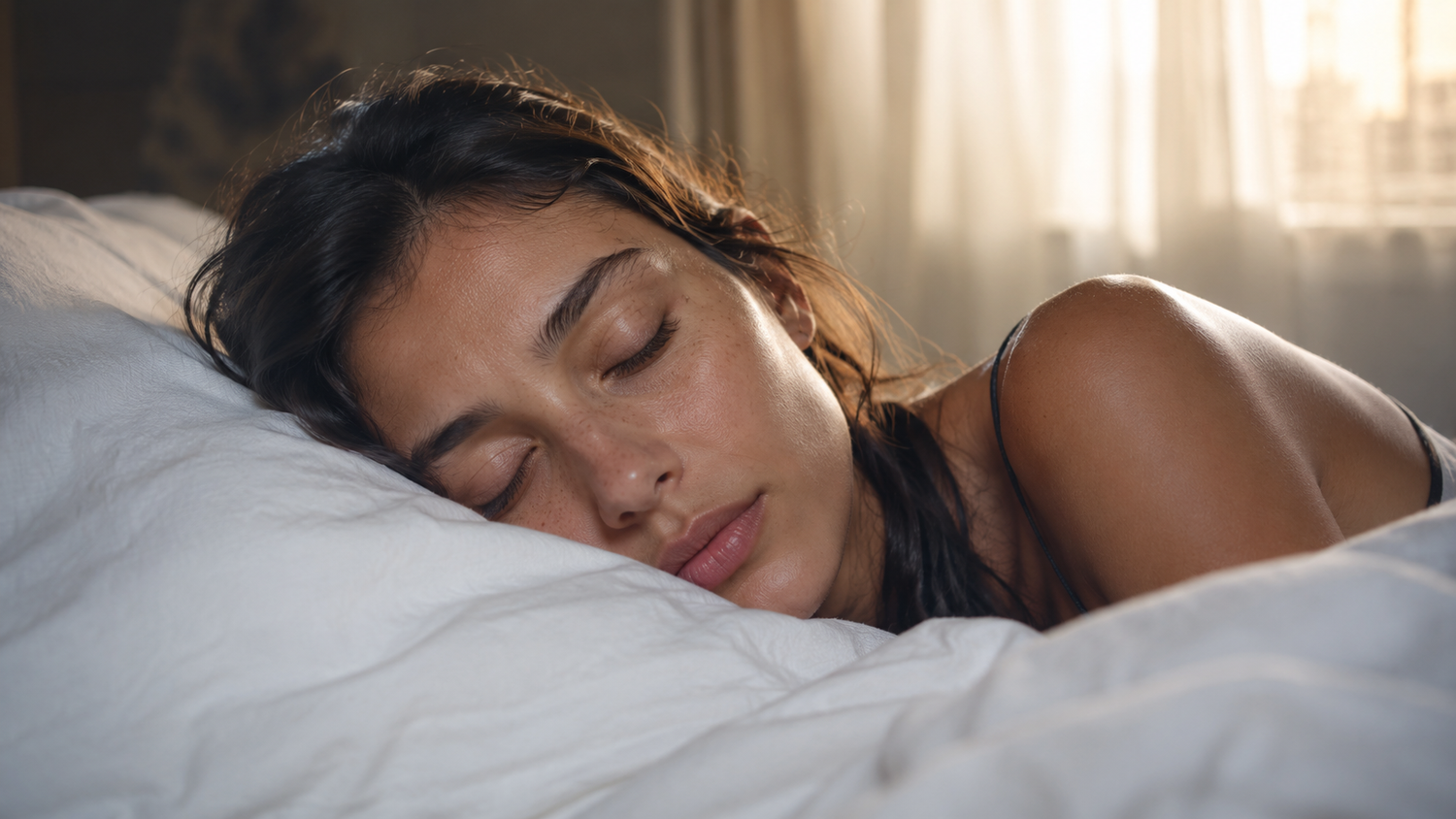
The Light That Wakes You Up Is Still On at 11pm
You know the routine. Midnight scroll. Bright white kitchen light while you make a herbal tea you tell yourself will help. Bedroom lamp set to 'Daylight' because it was cheaper than the warm one. Then you wonder why your brain refuses to wind down.
It is not just blue light. It is which light you are still standing under in the last two hours of your day.
This piece is about the opposite end of the spectrum. About red and near-infrared light, what the research suggests it might do for sleep and recovery, where the evidence is genuinely interesting, and where it is being oversold. The honest version. Useful if you are thinking about red light therapy as part of a wind-down routine, useful if you are just curious about what evening light is doing to you.
A One-Paragraph Recap of How Light Talks to Your Brain
Inside your eye there is a small group of cells that do not help you see. They sit behind your retina and their only job is to report light intensity back to a clock in your brain called the suprachiasmatic nucleus. That clock decides when to release melatonin, when to drop your core body temperature, and when to start the slow process of getting you ready for sleep. The cells that report to it are most sensitive to short-wavelength blue and white light. They are largely indifferent to long-wavelength red light.
That single fact is the reason this conversation exists. Two different lamps can feel similarly bright to your eye, but they are sending very different messages to that clock.
Why Blue and White Light Are the Problem at Night
In the 90 to 120 minutes before bed your body is supposed to be quietly tipping into a melatonin-rising state. Bright blue and white light, the kind that pours out of overhead LEDs, kitchen pendants, laptops and phones, tells your suprachiasmatic nucleus that it is still daytime. Melatonin release gets delayed. Core body temperature stays higher than it should. The wind-down stops winding down.
This part is not new and not controversial. Sleep researchers have been ringing this bell for two decades. The standard advice that came out of it is sensible: dim your lights in the evening, use warm-tone bulbs, switch screens to night mode, get some morning sunlight to anchor the clock at the other end.
What is newer is the conversation about whether the warmth itself, the long-wavelength end of the spectrum, has anything useful to add beyond just 'be dimmer'.
Where Red and Near-Infrared Sit on the Spectrum
Red light sits around 620 to 700 nanometres. Near-infrared sits above that, roughly 700 to 1000 nanometres, beyond what your eye can register. Both wavelengths are present in natural sunlight. Crucially, both are also present at sunset, which is the cue the human nervous system has been calibrated to for a few hundred thousand years.
The cells that signal 'it is still daytime' to your brain clock barely react to these wavelengths. That is the structural reason red and near-infrared light tend to come up in evening recovery and wind-down conversations. They are at the wrong end of the spectrum to suppress melatonin in the same way shorter wavelengths do.
That alone is not a sleep claim. It is a 'this light is not actively working against you' statement. The interesting question is whether evening exposure to these wavelengths does anything beyond just being benign.
What the Research Actually Shows
Here is the honest summary. The research is real, the research is limited, and there is a difference.
A 2012 study by Zhao and colleagues at the University of Beijing exposed female basketball players to 30 minutes of red light therapy every night for 14 days before bed. The trial reported improvements in sleep quality scores and in serum melatonin compared to placebo. Small study, athlete population, specific protocol. Useful as a signal, not a definitive answer.
A small 2019 study in the Journal of Athletic Training looked at red light at 660 nanometres for muscle recovery and reported improvements in perceived sleep alongside the recovery effects. Again, small population, specific use case.
Wider photobiomodulation research, the umbrella term for what red and near-infrared light does at the cellular level, has been building since the late 1960s. The mechanism is fairly well understood: long-wavelength light is absorbed by an enzyme called cytochrome c oxidase inside the mitochondria, which appears to support cellular energy production. Whether better daytime cellular energy translates into better overnight sleep is exactly the kind of question the literature is currently working on.
What we do not have is a large, replicated, gold-standard randomised controlled trial showing that red light therapy in the evening reliably improves objectively measured sleep across the general adult population. Anyone telling you otherwise is selling you something.
What we have instead is a growing body of small studies, a plausible biological mechanism, a long history of clinical use in adjacent areas like wound healing and skin, and a lot of self-reported user data. That is enough to call it 'an interesting and reasonable thing to try'. It is not enough to call it 'a sleep cure'.
What a Sensible Evening Protocol Actually Looks Like
If you decide to bring red light therapy into your evening, the protocol is not complicated.
Session length: 10 to 20 minutes is the range most consumer devices are built around. Longer is not better here.
Timing: Roughly 60 to 90 minutes before you plan to be asleep. Late enough that it sits inside your wind-down. Early enough that you are not staring directly into a device immediately before lying down.
Setting: Dim the rest of the room. The point of an evening session is to be inside a calmer light environment overall. A bright overhead light defeats most of the purpose.
What you do during it: Nothing useful. This is part of the appeal. You are not meant to be scrolling or working through it. Most people read, sit, breathe, listen to something low and slow, or just stare at the wall for 15 minutes. The forced 'no screens, no admin' window is half the benefit of the routine, completely separately from the light itself.
How often: Three to five evenings a week is a sensible rhythm to start with. Daily is fine if you genuinely enjoy it.
If you are using a full-body panel like the Lumovex Pro Panel 540, the natural setup is on its stand in the bedroom corner, with you sat or lying about half a metre away. If you are using a face device like the Spectrum Pro Mask, the same 10-to-20 minute window fits comfortably into a wind-down routine and pulls double duty with your skincare.
What This Will Not Do
This is the section every honest piece about sleep needs and most brands skip.
A red light session will not fix a sleep environment that is too bright, too warm, or built around a television playing in bed. It will not undo two hours of phone scrolling that immediately preceded it. It will not make a stressful inbox feel less stressful. It will not replace a proper sleep schedule, and it absolutely will not treat sleep apnoea, restless legs, or any other clinical sleep disorder. If you suspect one of those, the answer is your GP and a sleep clinic, not a panel.
It is also not a substitute for melatonin. Some marketing copy floating around the wellness space implies it 'boosts' melatonin in a way that competes with supplements. That overstates the case. The honest framing is that long-wavelength light does not suppress melatonin in the way shorter wavelengths do. 'Does not actively get in the way' is not the same as 'actively raises'.
A red light therapy session works best as one piece of a wider wind-down routine. The other pieces are unglamorous and free: dim the house, screens off an hour before bed, cooler bedroom, consistent schedule, daylight in the morning. None of that has changed.
Where This Matters More for Some People
Three groups of people have a stronger case for taking evening light seriously.
Perimenopausal women. Sleep disruption is one of the most under-discussed symptoms of perimenopause, often driven by a combination of falling oestrogen, night sweats, and a slowly drifting circadian rhythm. Anything in the wind-down toolkit that does not interfere with that fragile drift is worth considering. If skin changes are also part of the picture, the Spectrum Pro Mask folds the two routines into one ten-minute window in the evening.
Recovery-focused athletes. The original evidence base for evening red light therapy actually came out of sports research. If you are training hard, the evening session doubles as a low-effort recovery slot. The Pro Panel 540 is the format most athletes default to here because it covers more body in one session.
Shift workers and older adults. Both groups deal with a flatter, less responsive circadian rhythm. Neither will be cured by a panel, but both have the most to gain from being deliberate about the light environment in the hours before sleep. The evidence is thinner here but the logic is consistent.
If none of these apply to you and you sleep fine, you do not need a panel to sleep better. You probably need it for something else, or not at all.
How Lumovex Fits Into an Evening Routine
We make the panel and the mask. Both work as evening devices.
The Pro Panel 540 is the obvious wind-down anchor. Set up in the bedroom corner, 10 to 20 minutes at a comfortable distance, lights dimmed elsewhere in the room. It is the format most people enjoy as a daily ritual because it covers the whole body in one session and you can pair it with reading.
The Spectrum Pro Mask is the other entry point, especially if your main interest is skin and the sleep angle is the bonus. The mask sits on for 10 minutes, you do nothing else during it, and it lands inside that 60-to-90-minutes-before-bed window naturally.
Both come with free UK mainland delivery, 30-day returns, 2-year warranty. If you are trying the routine and it does not stick, the device goes back. Honest experiment with a defined exit.
Frequently Asked Questions
Does red light therapy actually help with sleep?
The honest answer is 'maybe, and the early evidence is interesting'. Small studies suggest some users may see improvements in self-reported sleep quality. There is no large, definitive trial yet. It is reasonable to try as part of a wider wind-down routine. It is not reasonable to expect it to fix sleep on its own.
When is the best time to use it before bed?
Most protocols suggest 60 to 90 minutes before your planned sleep time. Late enough that it sits inside your evening wind-down, early enough that you are not using a device immediately before lying down. Adjust around your actual schedule rather than chasing a perfect window.
Is it safe to use every night?
For most healthy adults, yes. Standard red and near-infrared therapy at consumer device intensities has a long safety record. If you have an underlying medical condition, take photosensitising medication, are pregnant, or have a history of light-sensitive epilepsy, check with your GP first. Always use the eye protection that comes with your device.
Can it replace my current sleep aid?
No, and you should not stop a prescribed sleep medication on the basis of any wellness article including this one. Red light therapy at home is best thought of as one piece of an evening routine, not a swap for medical care. If you are on a prescribed sleep aid and want to change anything, talk to whoever prescribed it.



Leave a comment
This site is protected by hCaptcha and the hCaptcha Privacy Policy and Terms of Service apply.