

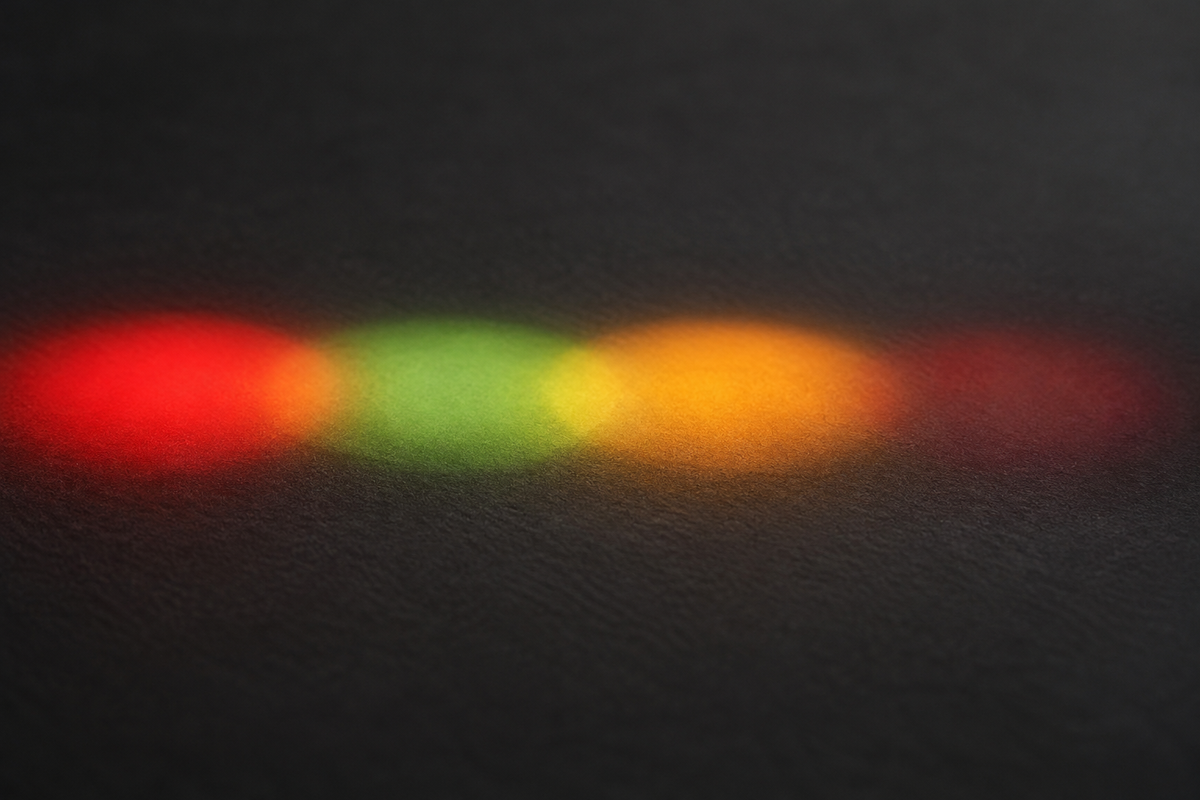
Most LED face mask colours do different jobs because each colour is a different wavelength, and the wavelength decides how deep the light travels into skin. Red light (around 630 to 660nm) is the most studied for skin tone and texture, near-infrared (around 810 to 850nm) reaches deepest, and amber and green sit at the shallow end with a smaller research base. Here is what each colour is, what the evidence suggests, and how to pick a mode.
Contents
- Why LED masks come in different colours
- Red light (630 to 660nm)
- Near-infrared (810 to 850nm)
- Amber or yellow light (570 to 590nm)
- Green light (around 520 to 560nm)
- What about blue?
- How to choose a mode for your skin
- FAQ
Why LED masks come in different colours
An LED's colour is simply its wavelength, measured in nanometres (nm). Shorter wavelengths, such as blue and green, are absorbed close to the surface. Longer wavelengths, such as red and near-infrared, travel further down. That is the physics behind every colour setting on a mask.
Researchers call the underlying effect photobiomodulation: light is absorbed by the cell's energy machinery (mitochondria), which is thought to influence cellular energy and repair signalling. A 2025 review of LED use in cosmetic dermatology, indexed on PubMed, groups the clinically used wavelengths into blue, yellow, red and near-infrared bands, and notes that safety is a major advantage of the approach.
The catch is that the colours are not equally well studied. Some have decades of trials behind them. Others are mostly small studies and clinic experience. Marketing rarely tells you which is which, so this guide does.
Red light (630 to 660nm)
Red is the workhorse. It reaches roughly 2 to 3mm into the skin, which is where the collagen-producing cells (fibroblasts) sit. It is the colour with the largest body of research for skin appearance.
- What the research suggests: a randomised, sham-controlled split-face study by Lee and colleagues (2007, Journal of Photochemistry and Photobiology B) treated 76 people with LED light at 633nm, 830nm or both, twice a week for four weeks, and reported measurable reductions in wrinkles and gains in skin elasticity compared with how their skin measured before treatment. A later controlled trial by Wunsch and Matuschka (2014, Photomedicine and Laser Surgery) reported improvements in skin complexion and collagen density with red and near-infrared light compared with an untreated group.
- What people use it for: the look of fine lines, firmness, tone and general skin texture.
- Honest limit: results are gradual and depend on consistency. Think weeks, not days, and think "may help", not "will fix".
On the Lumovex Spectrum Pro LED face mask, the Rejuvenate mode is 660nm red light.
Near-infrared (810 to 850nm)
Near-infrared is invisible, so you will not see it as a colour. You may notice a faint glow or gentle warmth. It penetrates much deeper than red, roughly 5 to 10mm, so it reaches beyond the skin into the tissue underneath.
- What the research suggests: near-infrared is the wavelength most associated with muscle and joint recovery studies, and it appears alongside red in many skin trials, including the 830nm arm of the Lee study above.
- What people use it for: a deeper, more "supportive" session. On the face, that often means a calming, comfort-focused routine.
- Honest limit: because you cannot see it, you cannot tell it is working by looking. Trust the spec sheet, not your eyes.
The Spectrum Pro's Deep Repair mode uses 850nm near-infrared on its own, so you are getting one wavelength per mode rather than a blend.
Amber or yellow light (570 to 590nm)
Amber sits between green and red. It is absorbed more shallowly than red, so it is aimed at the upper layers of skin.
- What the research suggests: yellow light around 570 to 590nm is the third band in the cosmetic dermatology review above, and is discussed in connection with skin tone and the look of redness. The evidence base is smaller than for red, and many studies combine amber with other wavelengths, which makes it hard to credit amber alone.
- What people use it for: brightening and evening the look of skin tone.
- Honest limit: treat the claims as promising rather than proven.
On the Spectrum Pro, Brighten mode is 590nm amber.
Green light (around 520 to 560nm)
Green is the shortest visible wavelength among the "skin-friendly" colours here, and it stays near the surface. It is the least researched of the four, and that is worth saying plainly.
- What the research suggests: green light is discussed in smaller studies and clinic practice in relation to the look of uneven tone and dark patches, and it is often described as a gentle, soothing colour to use. Large, independent trials are scarce.
- What people use it for: a calmer routine, particularly for skin that feels reactive, and for evening out the appearance of tone.
- Honest limit: if you have specific pigmentation concerns, such as melasma, green light is not a substitute for daily SPF or advice from a dermatologist. Our guide to red light therapy for melasma and hyperpigmentation goes through what is realistic.
The Spectrum Pro's Calm mode is 525nm green.
What about blue?
Blue light (around 415 to 470nm) is the colour most associated with acne-prone skin, because it works at the surface where breakout-linked bacteria live. It is a different tool for a different job, and the Spectrum Pro does not include a blue mode. If breakouts are your main concern, read our comparison of red light vs blue light therapy before buying.
How to choose a mode for your skin

A quick, honest way to match goal to colour:
| If you want... | Start with | Wavelength |
|---|---|---|
| Smoother-looking texture and fine lines | Red (Rejuvenate) | 660nm |
| A deeper, comfort-focused session | Near-infrared (Deep Repair) | 850nm |
| A brighter, more even-looking tone | Amber (Brighten) | 590nm |
| A gentler routine for skin that feels reactive | Green (Calm) | 525nm |
Three practical tips:
- Pick one main goal and give it 8 weeks. Skin changes slowly. Switching colour every session makes it impossible to tell what is helping.
- Red is the sensible default. If you are unsure, it has the strongest evidence base, and our wavelengths guide explains why 660nm is so widely used.
- More colours is not automatically better. The number that matters is whether each wavelength is specified and powered properly. See our UK LED face mask comparison for how brands stack up on this.
A note on eye comfort
With any LED mask, follow the manufacturer's guidance and do not stare directly into the LEDs. The Spectrum Pro has an open visor so you can see through it, but the habit is the same: relax, keep your gaze soft and avoid looking straight at the light. Our guide to LED face mask eye safety covers it in more detail.
The bottom line
Colour matters because wavelength decides depth. Red and near-infrared have the strongest research behind them. Amber and green are interesting additions with a smaller evidence base, best treated as supportive options rather than headline features. If you want to see all four wavelengths in one place, the Spectrum Pro Mask has 328 LEDs across four modes, and the Mask + Neck set adds a 60-LED neck piece. Either way, it comes with a 30-day return window and 2-year warranty.
Frequently Asked Questions
What do the different LED mask colours mean?
Each colour is a different wavelength of light. Red (630 to 660nm) and near-infrared (810 to 850nm) have the most research for skin and recovery, amber (570 to 590nm) is linked with tone, and green (around 520 to 560nm) is used for gentler, calming routines. Blue is mainly associated with acne-prone skin.
Which LED mask colour is best for anti-ageing?
Red light around 660nm has the strongest research base for the look of fine lines, firmness and texture, often paired with near-infrared. Results are gradual and vary from person to person.
Does green light on an LED mask do anything?
Green light is the least researched of the common colours. It is used in smaller studies and clinic practice for the look of uneven tone and for a calming routine, but large independent trials are limited, so it is best seen as a supportive option.
Can I use more than one LED colour in the same session?
You can run different modes on different days or one after another. Many people keep to one main goal for around eight weeks so they can tell what suits their skin.
Why can't I see near-infrared light?
Near-infrared sits beyond the visible spectrum (above roughly 700nm). You may notice a faint glow or gentle warmth, but the light itself is invisible, so check the wavelength on the spec sheet.
Is an LED mask with more colours better?
Not automatically. What matters is that each wavelength is clearly specified and delivered with adequate power. A mask with fewer well-specified colours can beat one with many vague ones.




Leave a comment
This site is protected by hCaptcha and the hCaptcha Privacy Policy and Terms of Service apply.