

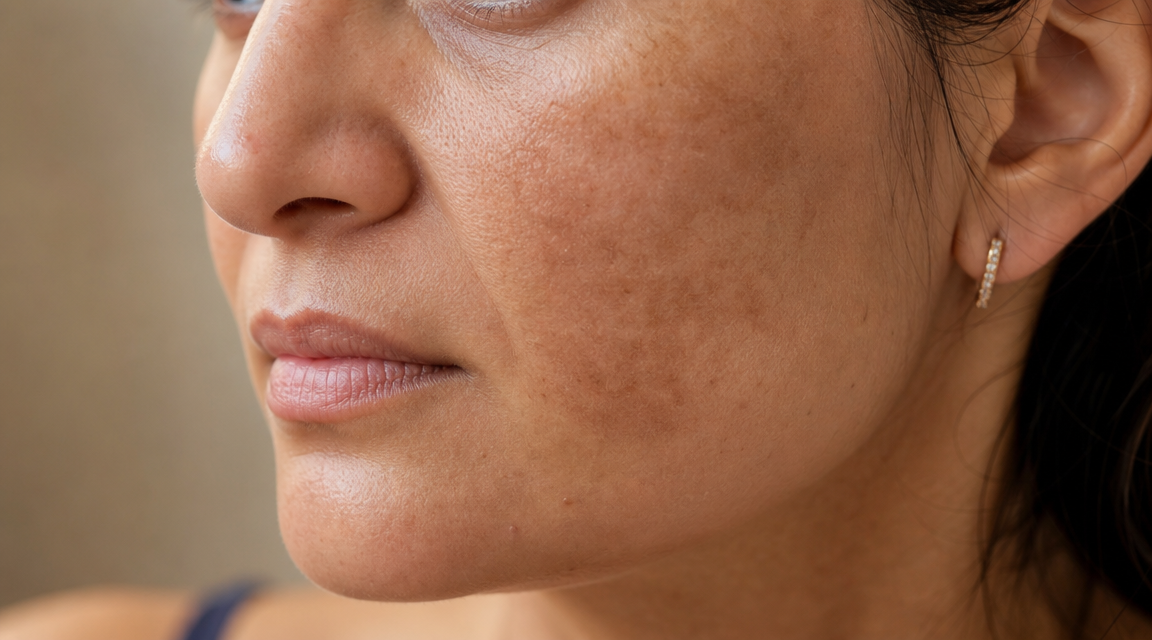
Hyperpigmentation that does not behave like sun damage, the kind that sits on your cheekbones, your upper lip, your forehead, and refuses to fade, has a different story behind it. It is one of the most common things women bring to a dermatologist's chair in their 30s and 40s, and one of the least well-explained on the high street. The two main types we are talking about here are melasma and post-inflammatory hyperpigmentation. Both are slow to develop. Both are slow to resolve. And both are increasingly part of the conversation around at-home red light therapy.
This guide is not about sunspots or freckles from a holiday week. (For that, see our companion guide on red light therapy for sun-damaged skin.) This one is about the dark patches that show up without an obvious trigger, the marks left behind after a breakout that took six months to fade, and the way hormone changes around perimenopause can quietly push more melanin into already-vulnerable areas of the face.
What melasma actually is
Melasma is a chronic pigmentary condition. It tends to show up symmetrically on the face, most often across the cheekbones, the forehead, the upper lip, and the bridge of the nose. The patches are usually brown or grey-brown, with soft edges rather than sharp boundaries. It often appears or worsens during pregnancy (which is where the old name "the mask of pregnancy" comes from), when starting or stopping hormonal contraception, or as women move into perimenopause.
The mechanism is the trick. Melasma is not a tan and it is not damage from a single event. The pigment-producing cells in the affected areas (melanocytes) become hyperactive, producing more pigment in response to triggers that would not normally cause much. Hormones, in particular oestrogen and progesterone, are believed to make these melanocytes more responsive. UV exposure, heat, and visible light then act as the day-to-day amplifiers that keep the patches refreshed.
This is why melasma is so persistent. The cells are not damaged. They are sensitised. Removing one trigger (say, finishing a pregnancy) does not switch the others off. The British Association of Dermatologists has a good plain-English overview if you want to read more.
Post-inflammatory hyperpigmentation (PIH)
The second big category is the one most people will recognise without knowing its name. Post-inflammatory hyperpigmentation is the dark mark left behind after the skin has been inflamed. A spot, a patch of eczema, an ingrown hair, a scab someone could not leave alone. The original irritation clears, but the pigment stays for weeks, months, or longer.
PIH happens because inflammation tells melanocytes to ramp up pigment production in the affected area. The deeper the inflammation went, the deeper the pigment can sit, and the harder it is to clear. PIH is more common and more stubborn in medium and darker skin tones, where the melanocytes are simply more active to begin with.
The honest summary on PIH: prevention is easier than reversal. Calming the original inflammation quickly, not picking, and keeping the area protected from UV all stack the odds in your favour. Once the mark is there, the skin needs time and patience to cycle it out.
Where hormones fit in
Perimenopause complicates the picture for a lot of women. As oestrogen levels become more variable through the late 30s and into the 40s and 50s, melasma that had been dormant can reactivate, and PIH from new breakouts can take longer to fade than it used to. Skin that managed itself through your 20s can start to feel less predictable.
This is not imagined and it is not vanity. The same hormonal shifts that change the skin's collagen behaviour also change how pigment cycles. Many of the women who come to us about an LED mask in their 40s arrive with a mix of fine lines, slower-fading marks, and uneven tone. Three problems that share an underlying root.
For a deeper look at the wider perimenopause and skin connection, see our guide on red light therapy for perimenopausal skin.
How red light therapy is thought to support
Red light therapy works through a mechanism called photobiomodulation. Specific wavelengths of red and near-infrared light interact with mitochondria, the energy-producing structures inside skin cells, and the interaction is thought to give cells a small additional energy reserve to support normal repair and turnover.
For pigmentation specifically, the evidence base is more nuanced than for, say, fine lines. Red light is not a depigmenting agent. It does not bleach or actively break down melanin. What it may do, over weeks of consistent use, is support a calmer baseline in the skin. Lower-grade inflammation, better barrier function, more efficient cell turnover. All of which are conditions in which both melasma and PIH tend to do better over time.
The honest framing is this: red light is part of a longer-term routine to help with the appearance of uneven tone. It is not a treatment for melasma or PIH. It is a supportive input that may help the skin do what it is already trying to do.
The Spectrum Pro LED Face Mask is designed for the face and upper neck, which is where melasma and facial PIH most often show up.
What red light therapy is not
Worth saying clearly, because pigmentation is a category where overpromising is the norm.
Red light is not a depigmenting treatment. It does not work the same way as prescription tyrosinase inhibitors, hydroquinone, tranexamic acid, or in-clinic procedures like chemical peels or pigment lasers. Those tools target pigment production or pigment removal directly. Red light works upstream, at the level of general skin recovery.
Red light is not a substitute for SPF. This one is absolutely central for anyone with melasma or PIH. UV exposure is one of the strongest triggers for both conditions. A broad-spectrum SPF, applied daily and reapplied through the day, is the single most effective thing anyone with pigmentation can do. The NHS sun safety guidance is the simplest place to start.
Red light is not a substitute for dermatological advice. Persistent melasma, large patches of PIH, or any pigmentation change that worries you is a conversation for a GP or dermatologist. Some pigmentation is medication-related. Some is condition-related. Some needs prescription input. A device is a long-term supporting role, not a diagnosis.
A realistic protocol
If you are working with melasma or PIH and want to add red light to your routine, here is roughly what most users settle into.
Frequency. Ten-minute sessions, daily or near-daily. Consistency matters far more than session length. Two ten-minute sessions a week will do less than ten of them.
Time of day. Many users prefer evening, after cleansing and before bed. The skin has the rest of the night to rest after the session.
What to pair with. Skin tolerates gentle, barrier-supportive ingredients well on light-therapy days. Niacinamide is a strong pairing for any pigmentation concern. It has been studied for its effect on melanosome transfer and is generally well-tolerated. A simple hyaluronic acid serum works for hydration. Vitamin C in the morning is the classic antioxidant choice.
What to be careful with. Strong actives on light-therapy days are usually too much for already-reactive skin. Layer your retinoids, AHAs, and any prescription pigmentation treatment on the off days, or at the opposite end of the day from the session. If a dermatologist has prescribed something specific, follow their guidance over any generic advice. They know your skin.
SPF, always. Light therapy without daily SPF is the equivalent of running a tap with the plug out. The mechanism you are trying to support during the session is the one UV exposure will undo during the day.
For body pigmentation on chest, shoulders, back, arms, or legs, the Pro Panel 540 covers larger areas in the same ten-minute window. The Spectrum Pro Mask + Neck bundle extends coverage down to the upper chest and decolletage, which is one of the most commonly affected areas for hormonal pigmentation that is rarely covered by a face-only device.
Timeline of visible change
This is the part that catches people out. Pigmentation moves on the slowest timescale of any skin concern.
Weeks 1-4. You will probably see nothing meaningful. The skin may feel calmer after sessions. Do not draw conclusions yet.
Weeks 4-12. Some users notice that the overall tone starts to feel more even, that new marks fade slightly faster than they used to. Existing melasma patches and older PIH tend to be much slower.
Months 3-6. This is usually where consistent users start to see softening of the patches themselves. Even then, the change is often subtle. A half-shade lighter, slightly softer edges. Photograph the same area in the same light at week zero and at week twelve. Side-by-side is the only honest way to judge pigmentation progress.
Beyond six months. Hormonal melasma in particular is a long game. The conversation is about managing it, not eliminating it. The combination of daily SPF, a calm routine, and consistent supportive inputs like red light tends to outperform any single intervention used in isolation.
Patience is genuinely the active ingredient here.
How Lumovex devices fit in
For face and neck, the Spectrum Pro LED Face Mask is the right tool. It is built around a ten-minute daily session and uses scientifically chosen red and near-infrared wavelengths designed to support skin recovery.
For users who want to cover the decolletage in the same session, useful for anyone whose pigmentation extends down to the chest, the Spectrum Pro Mask + Neck bundle extends the treatment area without adding session time.
For body pigmentation on chest, shoulders, back, arms, or legs, the Pro Panel 540 is the most flexible option and the most cost-effective way to cover multiple zones.
All Lumovex devices come with free UK mainland delivery, a 30-day return window, a 2-year warranty, and UK-based support.
Frequently asked questions
Can red light therapy clear melasma?
No device should be sold as a melasma cure, and we will not pretend otherwise. Red light may help with the appearance of pigmentation over months of consistent use, particularly when paired with daily SPF and a calm overall routine. For active or stubborn melasma, see a dermatologist for a treatment plan tailored to your skin.
How long until I see post-inflammatory marks fade?
PIH typically fades on a timescale of months, with or without any intervention. Consistent red light use, in combination with SPF and avoiding picking, may help support a faster, calmer fade. Deeper or older marks are slower.
Is red light therapy safe for darker skin tones?
Yes. Red light therapy does not work via heat-driven pigment targeting, which is the mechanism that makes some laser treatments riskier for darker skin. Photobiomodulation is generally well-tolerated across skin types. If you have any specific concerns, particularly an active flare of melasma or eczema, check with your dermatologist first.
Can I use red light alongside prescription pigmentation treatments?
Many people do, with their dermatologist's input. Common pairings include topical tranexamic acid, niacinamide, vitamin C, and prescribed depigmenting agents on alternate days. Always follow your dermatologist's protocol over generic advice.
Does red light worsen melasma the way heat does?
The concern about heat aggravating melasma is real and well-documented for high-output devices and saunas. Lumovex masks and panels are designed for at-home use and do not generate the kind of sustained heat associated with melasma flare. Most users tolerate sessions well. If you find your skin warming significantly during a session, shorten the session or check the device fit.
Is it safe to use red light during pregnancy?
The research base on red light therapy in pregnancy is limited. If you are pregnant or breastfeeding and considering an LED device, talk to your GP or midwife before starting.
A note on safety: Red light therapy is not a treatment for melasma, post-inflammatory hyperpigmentation, or any pigmentary condition. It is a supportive at-home routine that may help with the appearance of uneven tone over time. Daily broad-spectrum SPF and a dermatologist's input are the foundations of any pigmentation plan. The information in this article is educational and does not replace personalised medical advice.




Leave a comment
This site is protected by hCaptcha and the hCaptcha Privacy Policy and Terms of Service apply.