

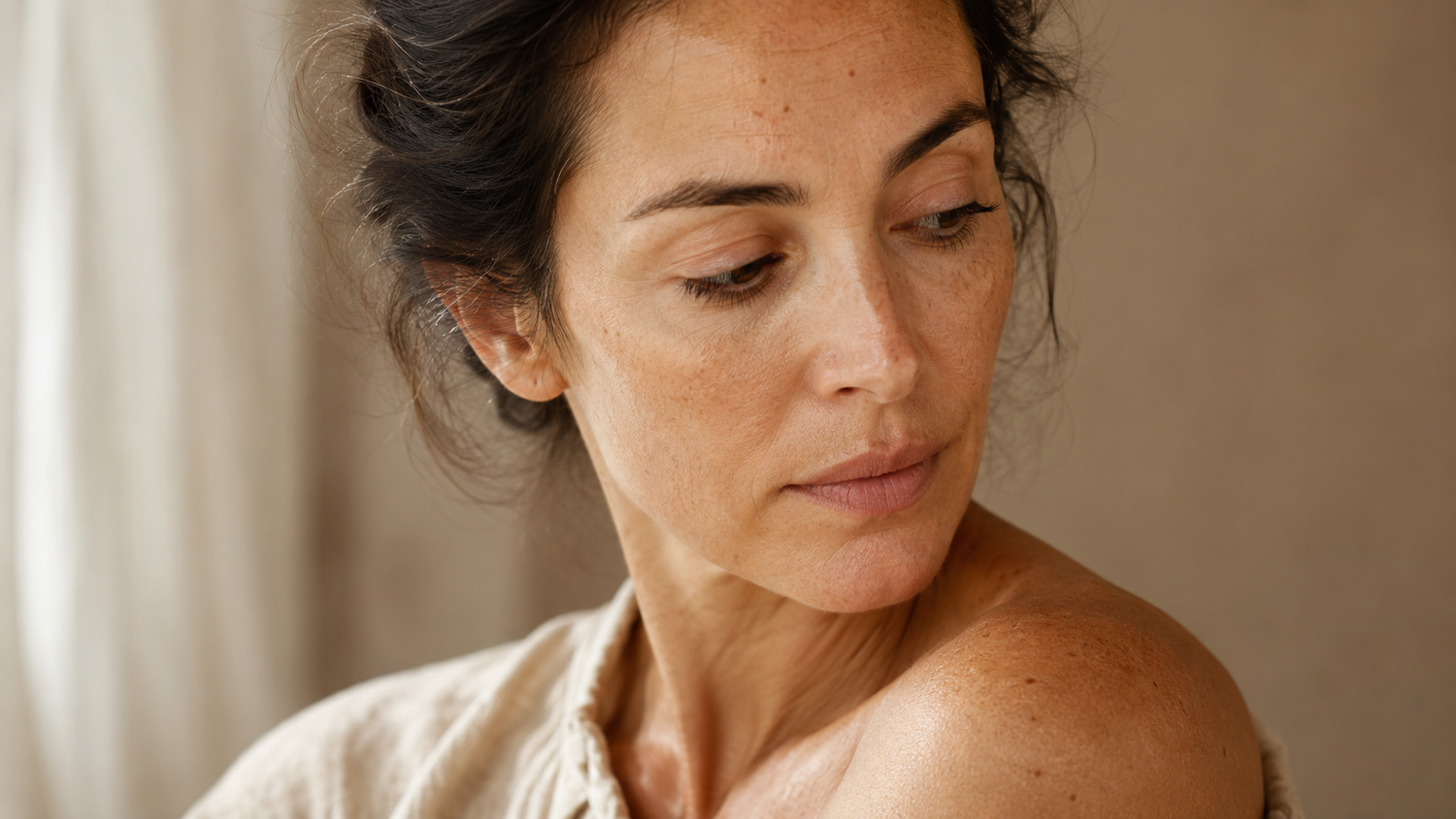
Sun damage is not a moment, it is a slow accumulation. Most of what shows up on the skin in your 40s and 50s started years before you noticed it. The good news is the skin keeps working on its own repair, quietly, for as long as you keep supporting it. Red light therapy for sun damage has become one of the more talked-about at-home tools in that conversation, and for good reason: the research on light, mitochondria, and skin recovery is finally catching up to what people have been doing in clinics for two decades.
This guide goes through what sun damage actually is, what red light is and is not doing for it, how to use it sensibly, and what to expect over the next few months.
What "sun damage" actually is
When we say "sun damage", we usually mean two different things layered on top of each other.
The first is the immediate stuff: redness, sting, tightness, a tan that turns into peeling. That is mostly UVB doing its work in the upper layers of the skin. It surfaces fast and clears in days to a couple of weeks.
The second is the slow build: fine lines that were not there before, uneven tone, sunspots, leathery texture, loss of bounce. That is UVA, which goes deeper into the skin and quietly degrades collagen, elastin, and the pigment-producing cells that keep your tone even. UVA does its damage years before you see it. By the time the freckles look like spots and the texture looks worn, the underlying changes have been happening since your twenties.
Sun damage is not a single event. It is a cumulative load, which is also why the recovery story is a long one. The British Skin Foundation has a good plain-English summary if you want to read more on how UV exposure shapes long-term skin health.
How red light is thought to support post-UV recovery
Red light therapy works through a mechanism called photobiomodulation. The short version: specific wavelengths of red and near-infrared light interact with mitochondria, the energy-producing structures inside skin cells. The interaction is thought to give cells a small additional energy reserve to do what they already want to do, including repair and collagen production.
The research on this is not new. Studies on red light and skin have been published consistently for over two decades, with consistent findings: red light may support collagen synthesis, may help moderate the inflammatory response, and may improve the overall appearance of skin texture and tone over weeks of regular use.
What this means in practice for sun-damaged skin is that red light is being used to support the skin's own recovery process from the kind of environmental stress UV exposure leaves behind. It is not undoing damage in a single session. It is giving the recovery machinery a steady nudge, day after day, for the months it takes to see change.
The Spectrum Pro LED Face Mask is designed for the face and upper neck, which is where most visible UV exposure tends to land.
What red light therapy is not
This part matters, because we would rather you know exactly what you are buying.
Red light therapy is not a substitute for sunscreen. The research on UV protection is unambiguous: broad-spectrum SPF, applied properly and reapplied through the day, is the single most effective intervention for preventing further sun damage. The NHS sun safety guidance is the simplest place to read the official recommendations. Red light supports recovery from past exposure. It does not protect you from the next exposure.
Red light is not a treatment for active sunburn. If your skin is hot, painful, blistered, or actively peeling, that is acute injury. Cool the skin, hydrate, and stay out of further sun. Red light therapy comes in later, once the burn has settled, as part of the longer recovery window.
Red light is not a substitute for medical advice. Any skin change that worries you, a mole that is shifting, a patch that will not heal, a spot that bleeds, is for your GP or a dermatologist, not a device.
We say this on the box and we will say it here too: red light is a recovery tool, not a shortcut.
The realistic protocol
For at-home red light use after sun exposure, the protocol most users settle into looks something like this.
Timing. Wait until the skin is no longer hot, red, or tender. For a mild day in the sun, that might be 24-48 hours. For a holiday week with stronger exposure, give it three to five days. If the skin is still inflamed when you put light on it, you are stressing already-stressed tissue.
Session length. Ten minutes per area is the standard for at-home devices like the Spectrum Pro Mask. Once a day is plenty in summer. Some users prefer every other day to make a single device cover face, decolletage, and shoulders across the week.
What to combine with. After a red light session, the skin responds well to gentle hydration. A simple hyaluronic acid serum or a fragrance-free moisturiser is a good follow. Niacinamide and vitamin C are both useful pairings for sun-stressed skin: niacinamide supports the skin barrier, vitamin C supports the kind of antioxidant load UV exposure runs down.
What to skip on light-therapy days. Strong retinoids, AHAs, or any active that has already left the skin tingling. Layer those in on the off days. Recovery and irritation work against each other.
If you are using the Pro Panel 540 for the body or the Red Light Therapy Belt for shoulders and back, the same logic applies: ten-minute sessions, daily or every other day, hydrate after.
Timeline of visible change
This is the part most people get wrong, and the part where most at-home red light reviews go sideways.
Skin does not change on the timescale of the news cycle. Collagen production is measured in months. Pigment turnover is measured in months. The cells doing the work of recovery cycle through on a roughly six-week clock.
A realistic timeline looks like this.
Weeks 1-4. You probably will not see much. Skin may feel a little calmer after sessions, less reactive in the evening. Do not judge anything yet.
Weeks 4-8. Tone starts to even out. Some users notice that recent sun-related redness fades faster. Texture starts to feel smoother in patches.
Weeks 8-12. This is when most users start to see fine-line softening and a more uniform overall tone. Older sun spots are slower; they are often only meaningfully changing by the three to six month mark.
Beyond 12 weeks. The deeper, accumulated UVA damage is the slowest layer to shift. Continued daily use over six to twelve months is what moves it.
The honest summary: red light is a small daily input that compounds. Expect a slow build, not a glow-up.
How Lumovex devices fit in
For the face and upper neck, the Spectrum Pro LED Face Mask is the right tool. It uses scientifically chosen red and near-infrared wavelengths designed to support skin recovery and is built around a single ten-minute daily session. For users who want to cover the decolletage in the same session, the Spectrum Pro Mask + Neck bundle extends coverage down to the upper chest, one of the most commonly sun-exposed and under-treated areas.
For the body, the Pro Panel 540 is the most flexible Lumovex device. It can be used on chest, back, shoulders, arms, or legs, ten minutes per area, and is the most cost-effective way to cover post-holiday recovery across multiple body zones.
For targeted areas, the Red Light Therapy Belt wraps around shoulders, back, knees, or hips for hands-free use. Useful if you have come back from a beach holiday with shoulders and chest that took the brunt.
All Lumovex devices come with a two-year warranty, free UK mainland delivery, and a 30-day return window. UK-based support, no subscriptions, no recurring costs.
Frequently asked questions
Can I use red light therapy on actively sunburned skin?
Not while it is hot, painful, or peeling. Cool the skin, hydrate, and stay out of the sun. Once the burn has fully settled, usually three to five days, red light may help support the longer recovery process.
How soon after a beach day can I use my mask?
If the skin is not red, warm, or tender, you can use it that evening. If it is still reactive, wait until it has calmed.
Does red light therapy replace SPF?
No. Red light supports recovery from past exposure. SPF prevents further exposure. They are not interchangeable, and broad-spectrum sunscreen remains the most important step in any sun-aware routine.
Can red light therapy reverse existing sun spots?
"Reverse" is too strong a word. Red light may help with the appearance of uneven tone over time, and many users see slow softening of pigmentation over several months. Older, deeper sunspots tend to be the most stubborn and may need a dermatologist's input for meaningful change.
Is red light therapy safe during pregnancy?
The research base on red light therapy in pregnancy is limited. If you are pregnant or breastfeeding, talk to your GP or midwife before starting any new skin-care device.
Can I do it every day through summer?
Yes, for most users. Ten-minute sessions are designed for daily use. If your skin feels reactive on a given day, take the day off and come back to it.
A note on safety: Red light therapy is not a substitute for sunscreen. Always use a broad-spectrum SPF and seek medical advice for severe sunburn or any skin change that concerns you. The information in this article is educational and does not replace personalised medical advice.




Leave a comment
This site is protected by hCaptcha and the hCaptcha Privacy Policy and Terms of Service apply.