


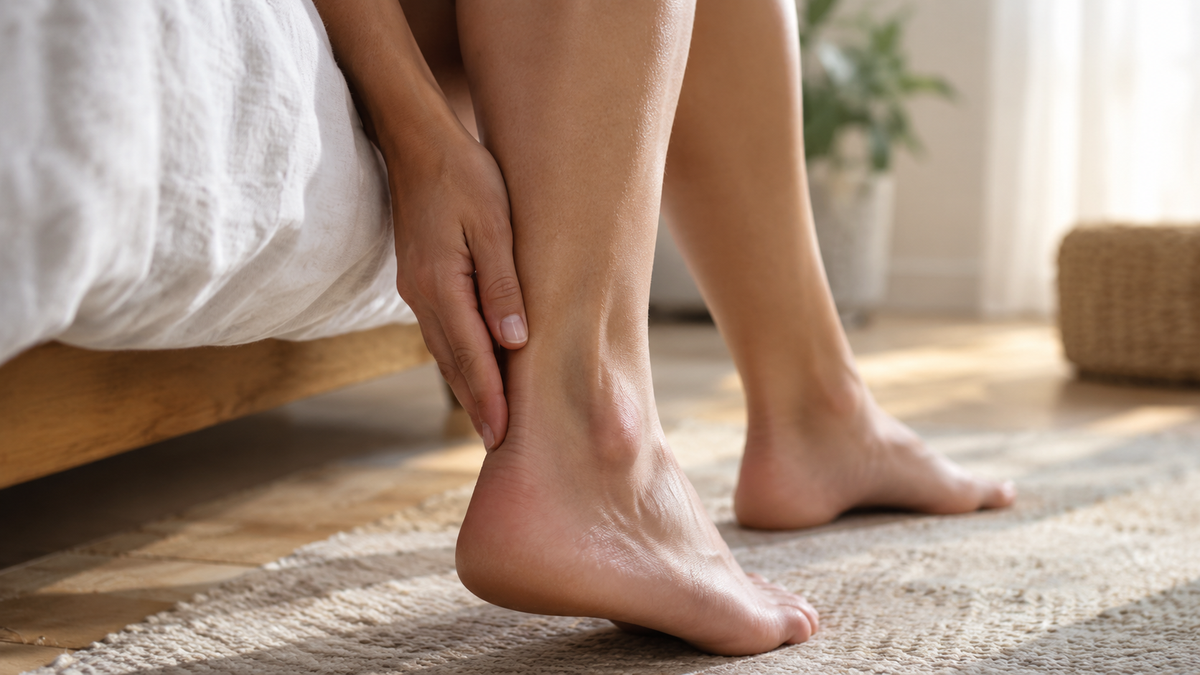
That first step out of bed, when your heel feels like it has been stabbed, is the signature of plantar fasciitis. If you have been searching for whether red light therapy can help plantar fasciitis and heel pain, the honest answer is that the research is cautiously encouraging but not a cure. Photobiomodulation, the proper name for red and near-infrared light therapy, has been studied for this exact problem, and the findings suggest it may help reduce pain and support the tissue repair process when used consistently alongside the basics that actually move the needle.
This is not a miracle fix, and anyone selling it as one is not being straight with you. What follows is a calm look at what the evidence says, what it does not, and how people realistically use light at home for stubborn heel pain.
What plantar fasciitis actually is
The plantar fascia is a thick band of connective tissue running along the sole of your foot, from the heel bone to the base of your toes. It acts like a spring that supports your arch. When it is overloaded, through running, long hours on your feet, tight calves, unsupportive footwear or a sudden jump in activity, tiny areas of the tissue become irritated and degraded.
Despite the name, long-standing plantar fasciitis is usually less about active inflammation and more about degeneration of the tissue, which is why some clinicians prefer the term plantar fasciopathy. That distinction matters, because it explains why anti-inflammatory approaches alone often fall short, and why treatments that support tissue repair and circulation are of interest.
How red light therapy is thought to work here
Red light therapy delivers specific wavelengths of light, typically around 660nm (red) and 850nm (near-infrared), into the skin and the tissue beneath it. The near-infrared wavelengths are the important ones for a structure as deep as the plantar fascia, because longer wavelengths penetrate further than visible red light.
The proposed mechanism is that this light is absorbed by the mitochondria in your cells, the tiny structures that produce energy. Research suggests this may increase cellular energy production, support local blood flow, and influence the signalling involved in tissue repair and pain. For a slow-healing, poorly circulated area like the sole of the foot, that theory is at least plausible. Plausible is not the same as proven, so let us look at what the trials found.
What the clinical evidence shows
Low-level laser therapy, which is closely related to LED-based red light therapy and shares the same photobiomodulation mechanism, has been tested for plantar fasciitis in several randomised controlled trials and pooled analyses.
The general pattern across this research is that people receiving light therapy tended to report greater reductions in heel pain than those given a placebo (sham) treatment, particularly over a course of several weeks. Some studies also noted improvements in morning pain and in function scores, which are the outcomes patients care about most.
Three honest caveats sit alongside those results:
- Study quality varies. Many trials are small, use different devices, doses and wavelengths, and run for different lengths of time. That makes it hard to state a precise expected result.
- Laser is not identical to a home LED device. Much of the strongest data uses clinical lasers. At-home LED panels work by the same principle but generally at lower intensity, so results at home are likely to be more gradual.
- It is rarely the whole answer. In the studies, light therapy was usually one part of a plan, not a standalone fix.
If you want to go deeper on the underlying science, systematic reviews of photobiomodulation for musculoskeletal pain are indexed on PubMed, and the Cochrane Library is the place to check how strong the overall evidence base is judged to be.
What red light therapy will not do
It will not lengthen a tight calf, correct the footwear that is overloading your foot, or undo a training error. Plantar fasciitis is a load problem at heart. Light may support the tissue and take the edge off the pain, but if the underlying overload stays the same, the problem tends to stay too.
The treatments with the strongest evidence for plantar fasciitis remain the unglamorous ones: calf and plantar fascia stretching, progressive loading exercises, supportive footwear or orthoses, and managing how much you are asking your feet to do. The NHS has a straightforward overview of these first-line steps, and it is worth reading before spending on any device. Think of red light as a possible support to that plan, not a replacement for it.
A realistic at-home approach
If you decide to try light therapy for heel pain, this is how people typically use it. None of this is medical advice, and persistent heel pain should be assessed by a GP, physiotherapist or podiatrist.
- Target the right spot. Aim the device at the base of the heel and along the arch, where the fascia runs. The sole is thick tissue, so near-infrared (around 850nm) matters more here than red light alone.
- Get close. Skin contact or near-contact delivers more of the light where you need it. A flexible pad or mat you can rest your foot on, or a small panel positioned close to the sole, tends to be more practical than a large upright panel for a foot.
- Keep sessions sensible. Around 10 to 20 minutes per session is typical. More is not better, as photobiomodulation follows a dose-response curve where there is a sweet spot rather than a the-more-the-better rule.
- Be consistent. Most people who report benefit use it most days across several weeks. One-off sessions are unlikely to do much. Our guide on how often to use red light therapy covers this in more detail.
- Stack it with the basics. Do your stretches and loading work. Light therapy alongside a proper rehab routine is the honest way to give yourself the best chance.
For heel and foot use specifically, a flexible mat you can rest your foot on, like the Lumovex Total Recovery Mat, or a compact panel you can position close to the sole, like the Lumovex Portable Panel, is usually the most practical format for a foot. If you are weighing up device types generally, our panel vs mask vs mat guide breaks down which suits which goal, and our full mat recovery guide goes deeper on lie-on-top sessions. If nerve-related foot symptoms are part of your picture, our piece on red light therapy for neuropathy and nerve pain is a useful companion read.
How long before you might notice anything
Be patient and realistic. Connective tissue heals slowly, and the foot is one of the hardest-working parts of the body. In the trials that showed benefit, improvements built over a course of weeks rather than days. If you are using an at-home LED device, expect the timeline to be at the longer end. If you have seen no change at all after six to eight weeks of consistent use combined with proper rehab, it is a signal to get the foot properly assessed rather than to simply keep going.
The honest bottom line
Red light therapy is a reasonable, low-risk thing to try for plantar fasciitis, with some supportive clinical evidence behind it and a plausible mechanism for a slow-healing, poorly circulated area. It is not a cure, and it works best as one part of a plan that also fixes the load on your foot. Used consistently, close to the skin, with near-infrared reaching the deeper tissue, it may help take the edge off heel pain while your body does the repair work.
Frequently asked questions
Does red light therapy work for plantar fasciitis?
The research is cautiously positive. Trials of low-level laser and light therapy have generally shown greater pain reduction than placebo over several weeks, though study quality varies and results at home are likely to be more gradual than in clinic. It works best alongside stretching, loading exercises and supportive footwear.
Which wavelength is best for heel pain?
Near-infrared, around 850nm, is the more relevant wavelength for plantar fasciitis because it penetrates deeper than visible red light, and the plantar fascia sits under thick tissue. A device offering both red (around 660nm) and near-infrared is the most versatile choice.
How long should I use red light therapy on my foot?
Around 10 to 20 minutes per session, most days, is a typical routine. More is not better. Consistency across several weeks matters far more than long individual sessions.
Can I use a red light panel or mat on my feet?
Yes. A flexible mat you rest your foot on, or a compact panel positioned close to the sole, tends to be more practical for a foot than a large upright panel, because getting the light close to the skin improves delivery.
Is red light therapy safe for heel pain?
For most people it is low-risk and non-invasive, with no UV exposure. If your heel pain is severe, worsening, or accompanied by numbness, swelling or signs of infection, see a GP, physiotherapist or podiatrist rather than self-treating.



Leave a comment
This site is protected by hCaptcha and the hCaptcha Privacy Policy and Terms of Service apply.