

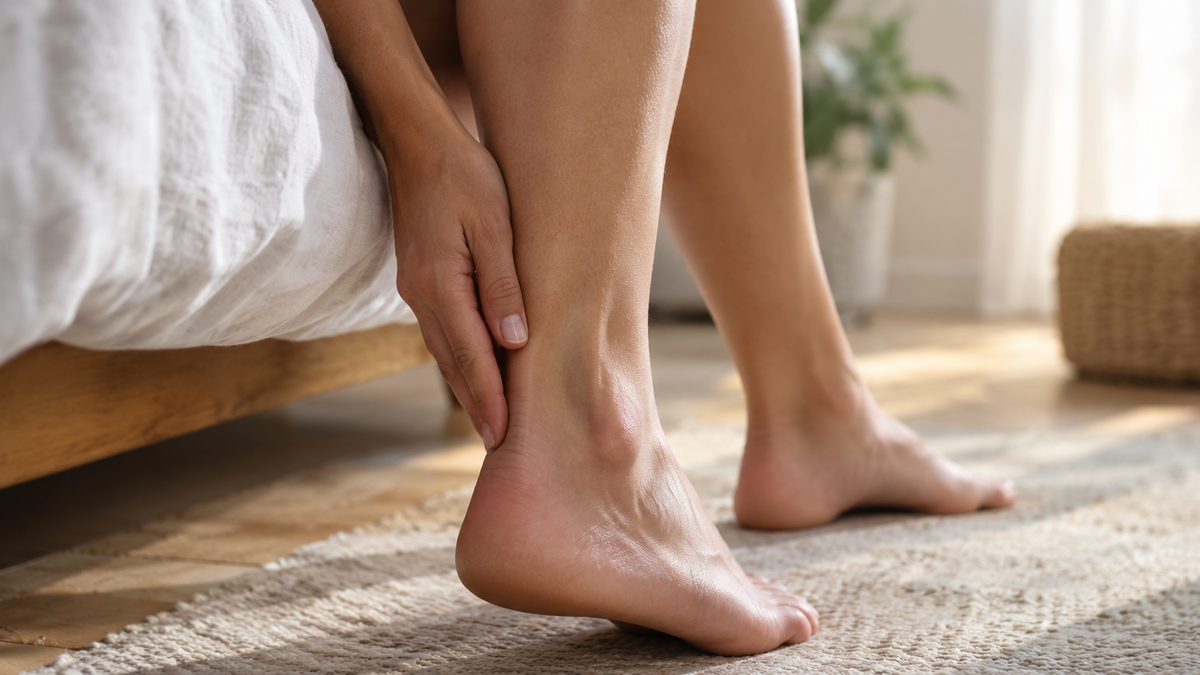
If you have ever felt a deep, stubborn ache or stiffness at the back of your heel, first thing in the morning or after a run, you already know how much the Achilles tendon can dominate your day. It is the strongest tendon in the body, and also one of the slowest to settle down once it is irritated. That combination is exactly why people go looking for anything that might speed the process along, red light therapy included.
So does it actually help? Here is the honest version, based on what the research on photobiomodulation and low-level laser therapy actually shows, along with a realistic idea of what an at-home routine can and cannot do.
What Achilles tendinopathy actually is
The word to notice is "tendinopathy", not "tendinitis". For years the assumption was that a sore Achilles was simply inflamed. Modern research paints a more useful picture: chronic Achilles pain is usually a problem of tendon structure, where the collagen fibres that make the tendon strong become disorganised and the tissue struggles to repair itself at the pace it is being loaded.
There are two common patterns. Mid-portion tendinopathy sits a few centimetres above the heel bone and is the more common form. Insertional tendinopathy sits right where the tendon meets the heel bone and tends to be more stubborn. This is a different problem to plantar fasciitis, which affects the band of tissue under the sole of the foot, so if your pain is under your foot rather than at the back of your heel, that is a separate issue.
Because the core problem is slow, disordered repair rather than simple swelling, the interesting question is whether light can support the cells doing that repair work.
How red light is thought to work on tendon
Red and near-infrared light in roughly the 660nm and 850nm range is absorbed by your cells, in particular by the mitochondria that produce most of a cell's energy. The leading explanation is that this light gives those mitochondria a temporary nudge, which research suggests may support local circulation, help modulate the inflammatory response, and encourage the fibroblast cells that lay down new collagen.
For a tendon, that theory matters more than it does for skin. Tendons have a notoriously poor blood supply, which is a big part of why they heal so slowly. Anything that may support the local cellular environment is at least aimed at the right target. Near-infrared wavelengths around 850nm are the relevant ones here, because they penetrate deeper than visible red and the Achilles sits below skin and a layer of tissue rather than right at the surface. The same logic applies to other stubborn tendons, such as the elbow, which we cover in our guide to tennis elbow and tendon pain.
That is the mechanism. Mechanism is not proof, so the more important question is what happened when researchers actually tested it on people.
What the studies found
The evidence base for light therapy on the Achilles is genuinely encouraging, though it is smaller and more mixed than the marketing around any recovery device would suggest.
Several controlled trials have looked at low-level laser therapy for Achilles tendinopathy, often alongside the exercise programmes that are the accepted first-line treatment. A number of them reported greater reductions in pain and tenderness when light therapy was added to a loading programme, compared with the loading programme alone or with a sham light. Laboratory and animal studies on injured tendon have pointed in a supportive direction too, showing better-organised collagen and improved tendon strength markers after light exposure. This fits with the broader picture from the wider clinical evidence on light therapy for pain relief.
The honest caveats matter just as much. The trials are small, they vary a lot in the wavelength, dose and timing they used, and some found no meaningful difference. A recurring theme in the research is that dose is everything: too little light appears to do nothing, and the results tend to show up over weeks of consistent use rather than after a single session. There is no credible study showing that light alone, without the loading exercises, resolves a chronic Achilles problem.
The fair summary is this: the research suggests red and near-infrared light may be a useful support to a proper rehab programme for Achilles tendinopathy, not a replacement for it, and not a quick fix.
A realistic at-home routine
If you want to try it, the sensible approach treats light as one layer on top of the things that are known to work.
Keep doing the loading. Progressive calf and heel-drop exercises, ideally guided by a physio, remain the treatment with the strongest evidence for Achilles tendinopathy. Light therapy sits alongside that, it does not replace it. This mirrors how athletes layer light onto training rather than instead of it, something we cover in our guide to red light therapy for muscle recovery.
Treat the right spot. Aim the device at the sore part of the tendon at the back of your ankle, with the light source close to the skin. Because the Achilles is a small, deep target, a focused device you can position accurately at the ankle works better than a broad panel used from across the room. Our Portable LED Panel is easy to prop at ankle height for exactly this kind of targeted session, and for people who also want to lie their calves and lower legs across a larger surface, the Total Recovery Mat covers more area in one go.
Be consistent, and be patient. Most protocols in the research used sessions of roughly ten to twenty minutes, several times a week, over a block of weeks. Tendons are slow, so give it a fair trial before judging it.
Watch what your tendon tells you. Light therapy should never hurt. If your pain is getting worse, is severe, or you felt a sudden pop or sharp tear, that needs a clinician, not a gadget. A suspected Achilles rupture is a medical issue, not something to self-manage with light.
The bottom line
Achilles tendinopathy is frustrating precisely because it is slow, and there is no honest way to make a tendon heal on a schedule that suits you. What the research suggests is that red and near-infrared light may support the local repair environment and, when added to a proper loading programme, may help with pain and progress over a period of weeks. It is a reasonable, low-risk thing to add to good rehab. It is not a substitute for the rehab, and anyone promising an overnight fix for an Achilles is not being straight with you.
If you already own a red light device, aiming it at the tendon a few times a week is a sensible, evidence-adjacent thing to try. If you are buying specifically for this, choose a focused device you can position accurately at the ankle rather than a large panel meant for whole-body sessions.
FAQ
Does red light therapy cure Achilles tendinopathy?
No. There is no evidence that light alone resolves a chronic Achilles problem. The research suggests it may support recovery when added to a progressive loading exercise programme, which remains the first-line treatment.
Which wavelength is best for the Achilles tendon?
Near-infrared light around 850nm is the relevant one, because it penetrates deeper than visible red and the tendon sits below the skin surface. Devices combining 660nm red and 850nm near-infrared cover both the surface and deeper tissue.
How long before I might notice a difference?
Most studies used sessions of around ten to twenty minutes, several times a week, over several weeks. Tendons heal slowly, so results, if they come, tend to appear over weeks rather than days.
Is it safe to use on a painful Achilles?
Red and near-infrared light therapy is non-invasive and should never hurt. It should not be used as a substitute for medical care. If your pain is severe, worsening, or followed a sudden pop or sharp tear, see a clinician, as that may be a rupture.
Is this the same as plantar fasciitis?
No. Plantar fasciitis affects the band of tissue under the sole of the foot. Achilles tendinopathy affects the tendon at the back of the heel and ankle. They are different problems, though both are common causes of foot and heel discomfort.



Leave a comment
This site is protected by hCaptcha and the hCaptcha Privacy Policy and Terms of Service apply.