
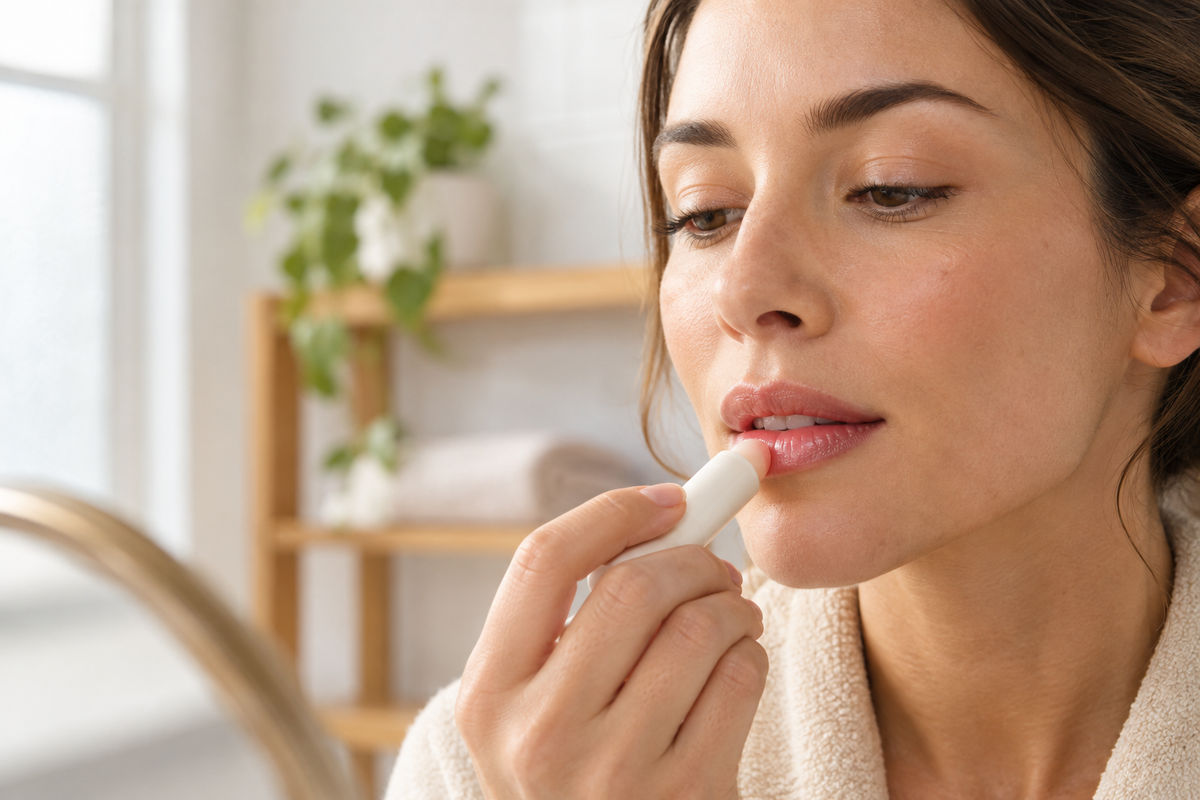
Can red light therapy help with cold sores? There is genuine clinical research on it, and some of it is striking, but it comes with big caveats. Most trials used clinical low-level lasers, they are small and old, and nothing here replaces antiviral cream or advice from your pharmacist or GP. Here is what was actually tested, what it means, and how to think about it if you get recurrent cold sores.
In this guide
- What cold sores are
- Why anyone studied light for cold sores
- What the trials found
- The limits of the evidence
- Using a home device sensibly
- Hygiene and safety
- FAQ
What cold sores are
Cold sores (herpes labialis) are caused by the herpes simplex virus, usually type 1. Once you have it, the virus lies dormant in nerve cells and can reactivate, typically around the lips, often after stress, illness, hormonal changes or sun exposure. Many people notice a tingle, itch or burning feeling a day or so before a blister appears.
Standard UK advice is simple: antiviral creams such as aciclovir, started at the first tingle, can help in some cases, and your pharmacist can advise. Cold sores usually clear up on their own in around 7 to 10 days. For frequent or severe outbreaks, a GP can discuss other options.
None of what follows changes that advice.
Why anyone studied light for cold sores
Red and near-infrared light, often called photobiomodulation, has been studied for decades for skin repair and nerve-related discomfort. Cold sores involve both: a viral reactivation along a nerve, and a lesion that needs to heal. Researchers asked two questions. Could light speed up healing of the sore? And could a course of light lengthen the gap before it comes back?
What the trials found
The recurrence trial. The best-known study is a randomised, double-blind, placebo-controlled trial by Schindl and Neumann, published in the Journal of Investigative Dermatology in 1999. Fifty people who got perioral herpes at least once a month for over six months were given either low-intensity laser light (690nm red) or a sham treatment. The laser group had daily sessions for two weeks, ten in total, and everyone was followed for 52 weeks.
The median time before the next outbreak was 37.5 weeks in the light group versus 3 weeks in the sham group. That is a big difference on paper.
The healing-time trial. A pilot study by Dougal and Kelly (Clinical and Experimental Dermatology, 2001) compared a single five-minute application of narrow-band 1072nm light against aciclovir cream applied five times a day, started within 36 hours of symptoms. The authors reported that the light group healed about four days sooner. It was a small pilot study, and 1072nm is outside the range home red light devices use.
The reviews. A 2018 systematic review of low-level laser therapy for recurrent herpes labialis described it as a potential option with no notable side effects, but called for larger, better-designed trials. An NHS medicines information summary reached a similar view: small studies with differing wavelengths and powers, generally positive, but not strong enough to be a standard recommendation.
The limits of the evidence
We want to be straight with you here, because this is a topic where hype is easy.
- Small and old. The landmark trial had 50 people and is from 1999. It has not been repeated at scale.
- Lasers, not LED masks. The studies used clinical lasers with defined wavelengths, intensities and doses. A consumer LED device is not the same thing.
- Specific protocols. The recurrence trial used a precise dose delivered daily for two weeks. Casual, occasional use is not the same.
- Not a cure. The virus stays in your nerves. Even in the best trial, outbreaks eventually returned.
- Not an antiviral. Light has not been shown to replace antiviral cream for active outbreaks.
So the fair reading is: the research is interesting and mostly positive, but too limited to promise anything. It may suit people who want to explore a supportive, non-drug extra alongside normal care.
Using a home device sensibly
If you get recurrent cold sores and want to discuss light with your pharmacist or GP, here is a cautious way to approach it.
- Do not skip standard care. If you feel a tingle, use your usual antiviral cream as advised.
- Stick to red light. Wavelengths around 630 to 690nm sit nearest to the red light used in the research. Check your device instructions for facial use.
- Keep your eyes comfortable. Do not stare into the LEDs at close range. Our eye safety guide covers this.
- Go small and targeted. A small handheld device suits a spot like the lip border better than full-face coverage. If you use the Sculpt Wand, use its red mode only, and keep it off any open or weeping sore.
- Be patient and track it. If you try light as part of a routine, note how often outbreaks happen over several months. One quiet month proves nothing.
Hygiene and safety
Cold sores are contagious, especially when blistered and weeping. This matters more than any light therapy question.
- Never share a device that has touched a sore, and clean contact surfaces thoroughly after any use near one. Our LED mask cleaning guide explains how.
- Do not put a face mask over an open or weeping sore. Contact can spread the virus around the face and onto the device.
- Wash your hands before and after touching your face or your device.
- Sun is a common trigger. Red and near-infrared light are not UV, but sun protection on the lips still matters.
- See your GP if cold sores are frequent, severe or spread near the eyes, or if you are pregnant, immunocompromised, or have eczema near the sore.
Our full safety guide lists who should take extra care with any light therapy device.
What about the skin once a sore has healed?
Separate from the virus itself, red light has a decent research base for general skin recovery, which is why people ask about it for marks and dryness afterwards. Our guides to wound healing and red light therapy for scars explain that evidence. Keep expectations modest: light may support the skin's normal recovery once a sore has fully crusted over and healed, but it will not make a sore disappear overnight.
FAQ
Does red light therapy get rid of cold sores?
No. The virus stays dormant in your nerves and light therapy has not been shown to remove it. Some small trials suggest light might shorten healing time or lengthen the gap between outbreaks, but the evidence is limited.
Can red light therapy prevent cold sores?
One 1999 randomised trial found longer gaps between outbreaks after a two-week course of low-level laser light, but it was small and used clinical equipment. It has not been confirmed in large modern trials.
Is it safe to use an LED mask with a cold sore?
Avoid putting a mask over an active, blistered sore. It is contagious and the device could pick up the virus. Always clean the device after any contact.
What wavelength is used for cold sores?
Studies have used wavelengths from 690nm red light to 1072nm near-infrared. Lumovex panels use red (660nm) and near-infrared (850nm) light, and the Spectrum Pro Mask includes a 660nm red mode alongside green, amber and near-infrared. None of them has been tested for cold sores specifically.
Should I use light therapy instead of aciclovir cream?
No. Antiviral creams remain the standard first-line option when started early. Talk to your pharmacist or GP about whether light could be an extra.
Is red light therapy safe on the lips?
Red light is non-ionising and generally considered low risk. Do not stare into the LEDs, follow your device guidance, and stop if you notice irritation.
The bottom line
There is real research suggesting light may influence cold sore recurrence and healing time, but it is small, dated, and based on clinical lasers rather than home LED devices. Treat it as an interesting, low-risk extra to discuss with your pharmacist or GP, never a replacement for antiviral care or good hygiene.
This article is for general information and is not medical advice. If you have frequent, severe or unusual cold sores, speak to your GP or pharmacist.



Leave a comment
This site is protected by hCaptcha and the hCaptcha Privacy Policy and Terms of Service apply.