Mental health treatments have not changed much in decades. Medication, talk therapy, lifestyle adjustments - these remain the core options for most people dealing with anxiety and chronic stress. But a growing body of clinical research is pointing to something unexpected: light.
Specifically, red and near-infrared light applied to the skin and scalp - a process called photobiomodulation - is showing genuine promise for mood regulation, anxiety reduction, and stress resilience. The research is still emerging, but what exists is surprisingly consistent.
Here is what we actually know, what remains uncertain, and what it means for you.
How Light Affects Your Brain
To understand why shining a light on your head might reduce anxiety, you need to understand what happens inside your cells when they absorb specific wavelengths of light.
Red light (630-660 nm) and near-infrared light (810-850 nm) penetrate the skin and are absorbed by cytochrome c oxidase, a photosensitive protein sitting inside your mitochondria. Mitochondria are the energy factories of every cell in your body - including your neurons.
When cytochrome c oxidase absorbs these wavelengths, three things happen:
- ATP production increases. Your cells generate more energy, which supports every downstream process from repair to signalling. Studies have documented ATP increases of 30-50% in treated tissues.
- Nitric oxide is released. This molecule relaxes blood vessel walls, improving circulation. In the brain, better blood flow to the prefrontal cortex - the region that regulates mood, decision-making, and emotional processing - may directly support better emotional regulation.
- Inflammation decreases. Chronic low-grade neuroinflammation is increasingly linked to anxiety and depression. Photobiomodulation triggers a controlled release of reactive oxygen species that activates the body's own anti-inflammatory cascade.
The combined effect is a brain that has more energy, better blood supply, and less inflammatory interference. That is a meaningful biological foundation for mood improvement - not a vague wellness claim.
What the Clinical Studies Show
The research on photobiomodulation for mental health has moved beyond theory. Several randomised controlled trials have produced measurable results.
Transcranial Photobiomodulation (tPBM)
The most studied approach involves directing near-infrared light through the forehead to reach the prefrontal cortex. The skull and scalp absorb some of the light, but enough penetrates to affect cortical tissue - particularly at the 810-830 nm wavelength range.
Key findings:
- A 2024 systematic review and meta-analysis published in Frontiers in Psychiatry analysed multiple randomised controlled trials and concluded that photobiomodulation is an effective treatment for depression with minimal side effects.
- A study on patients with major depressive disorder found that a single tPBM treatment at 810 nm with 60 J/cm² fluence produced significant and rapid reductions in both depression and anxiety scores. The improvements were sustained at 2-week and 4-week follow-ups.
- A double-blind randomised controlled trial on patients in methadone maintenance treatment - who commonly experience both anxiety and depression - found that a single tPBM session produced statistically significant reductions across all outcome measures compared to sham (placebo) treatment.
- The ELATED-2 pilot trial demonstrated effectiveness of transcranial photobiomodulation as a primary therapy for major depressive disorder, not merely an adjunct.
- Multi-watt tPBM studies using dual wavelengths (810/980 nm) reported that 92% of participants showed positive response, with 82% achieving remission.
These are not anecdotal reports. They are measured outcomes from controlled clinical environments with placebo groups.
LED-Based Studies
Importantly, these effects are not limited to expensive laser devices. A pilot study using near-infrared LED light applied to the forehead of patients with major depression and anxiety found improvements across all three outcome measures at 2 weeks. While improvements decreased slightly by week 4, they remained better than baseline throughout.
This matters because it suggests that consumer LED devices - not just clinical laser equipment - can deliver meaningful doses of therapeutic light to relevant brain regions.
The Stress Response Connection
Beyond the direct neurological effects, red light therapy appears to influence the autonomic nervous system - the system that controls your fight-or-flight and rest-and-digest responses.
Preliminary research suggests photobiomodulation can:
- Activate the parasympathetic nervous system, shifting the body away from chronic stress activation and toward recovery
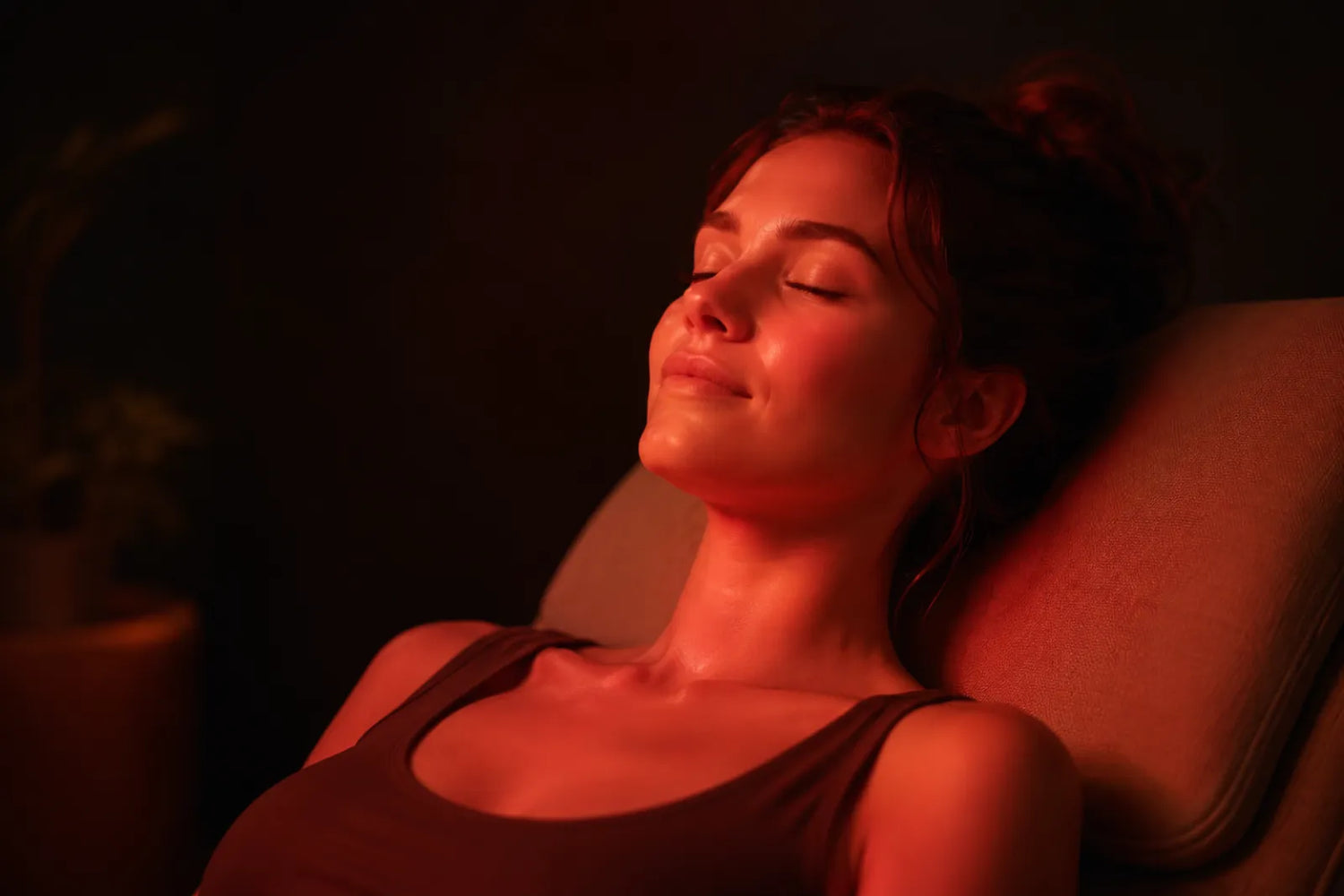
- Influence melatonin production, improving sleep quality - which is one of the strongest predictors of emotional resilience and anxiety management. For evening use, the Lumovex Total Recovery Mat delivers full-body near-infrared light while lying down, making it practical to incorporate into a wind-down routine before sleep
- Support neurogenesis (the growth of new neurons) and angiogenesis (new blood vessel formation) in the brain
- Enhance glymphatic clearance - the brain's waste removal system, which operates primarily during sleep and is impaired by chronic stress
For anyone living with chronic stress, these pathways represent a meaningful biological intervention. Not a replacement for professional mental health support, but a potentially valuable complement.
What This Means in Practice
If you are considering red light therapy as part of your approach to managing stress or anxiety, here is what the current evidence supports:
Wavelengths
Near-infrared light in the 808-850 nm range has the strongest evidence for reaching brain tissue through the skull. Red light at 660 nm supports skin-level benefits and may contribute through systemic anti-inflammatory effects.
A device that combines both wavelengths - like the Lumovex Spectrum Pro LED Face Mask, which uses both 660 nm red and 850 nm near-infrared LEDs - covers both the direct neurological pathway (NIR penetrating through the forehead) and the broader anti-inflammatory benefits (red light on the skin).
Session Protocol
Based on the clinical studies reviewed:
- Duration: 15-20 minutes per session
- Frequency: 3-5 times per week
- Consistency: Minimum 4 weeks before evaluating results, with optimal improvements typically seen at 4-8 weeks
- Target area: Forehead and face for mood-related benefits
Realistic Expectations
The research consistently shows:
- 20-30% symptom relief is a reasonable expectation by week 4 of consistent use
- Effects tend to be cumulative - building over weeks of regular sessions
- Photobiomodulation works best as an adjunct to existing approaches (therapy, exercise, sleep hygiene, social support) rather than a standalone solution
- Individual responses vary - some people notice improvements quickly, others take longer
What We Do Not Know Yet
Honest assessment matters. Here is where the science still has gaps:
Sample sizes remain small. Many of the most promising studies involve 10-50 participants. Larger randomised controlled trials are underway but have not yet reported.
Protocols are not standardised. Different studies use different wavelengths, power densities, session lengths, and treatment frequencies. There is no single agreed "best protocol" for mental health applications yet.
Long-term data is limited. Most studies follow participants for 4-8 weeks. Whether benefits persist with ongoing use, require maintenance sessions, or plateau over time is not yet well established.
Individual variation is real. Not everyone responds the same way. The factors that predict who benefits most - genetics, severity of symptoms, concurrent treatments - are still being mapped.
Regulatory status is clear. Photobiomodulation is not FDA-approved as a treatment for anxiety or depression. It is classified as investigational for these applications. The safety profile, however, is excellent - large-scale clinical trials have reported no significant adverse events compared to sham treatment.
A Tool, Not a Cure
Red light therapy is not going to replace therapy, medication, or the fundamentals of mental health management. Anyone dealing with serious anxiety or depression should work with a qualified professional.
But the evidence is increasingly clear that photobiomodulation offers a safe, non-invasive way to support mood regulation and stress resilience through well-understood biological mechanisms. It enhances cellular energy production, improves circulation to mood-regulating brain regions, and reduces the chronic inflammation that is increasingly implicated in mental health conditions.
For the cost of 15-20 minutes a few times a week, it is a low-risk addition to a broader wellbeing routine. The Lumovex Spectrum Pro range makes it straightforward to integrate into your existing self-care practice - the LED face mask delivers both red and near-infrared wavelengths directly where they are needed.
The science is not finished yet. But what it is saying so far is worth paying attention to.



Leave a comment
This site is protected by hCaptcha and the hCaptcha Privacy Policy and Terms of Service apply.