
So you've decided to try red light therapy. Great choice. Now comes the question: should you get a face mask or a panel? Both have their place, and the right answer depends on what you want to treat and how you like to use it. Here's how to decide.
The Quick Answer
If your focus is skincare and you want something effortless and consistent, a face mask is usually the best starting point. If you want to treat the body, joints, or large areas, or you want maximum flexibility, a panel is the more versatile tool. Many people eventually own both. The rest of this guide explains why.
LED Face Masks: The Breakdown
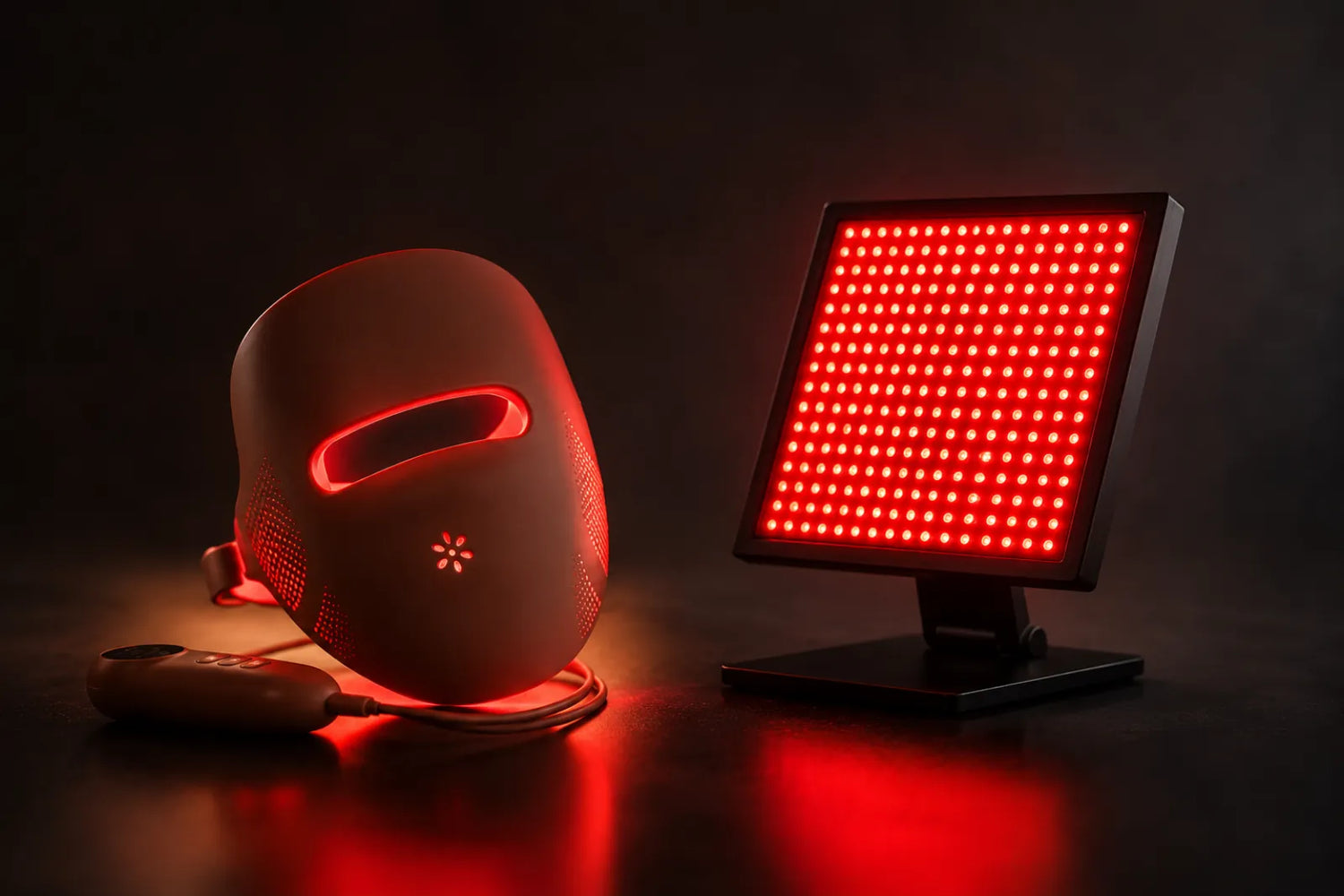
What they are: Wearable masks fitted with LED lights that cover your face, and sometimes the neck. The Lumovex Spectrum Pro Mask + Neck, for example, covers the face and decolletage in a single device, while the Spectrum Pro Mask focuses on the full face.
Pros:
- Hands-free convenience - wear it while doing other things
- Consistent coverage - LEDs sit at a fixed, optimal distance from the skin every time
- Targeted treatment - designed specifically for facial use
- Often wireless - no cords to manage
- Lower entry price - masks are generally more affordable than full-body panels
Cons:
- Face-only - can't treat body areas
- Fixed design - one shape, limited adjustability
- Battery life - wireless models need charging
Best for: people focused on skincare and anti-ageing, those who want effortless hands-free treatment, and anyone who struggles with consistency, since a mask makes daily use almost frictionless.
Red Light Panels: The Breakdown
What they are: Flat panels of LEDs that you position facing your treatment area. The Lumovex Pro Panel 540, with 289 LEDs across 660nm and 850nm, is a strong example for broad coverage, while the Portable Panel offers the same flexibility in a compact, travel-friendly form.
Pros:
- Versatile - treat the face, body, back, or joints, wherever you need it
- Customisable distance - adjust how close you sit based on the goal
- Often more powerful - higher irradiance options are available
- Broad coverage - a panel can treat larger areas in one session
Cons:
- Requires positioning - you need to hold, stand, or mount the device
- Less hands-free - you usually dedicate the session to it
- Takes up space - larger panels need somewhere to live
Best for: athletes and active people (muscle recovery), anyone with body-wide concerns such as joint discomfort or general wellness, and those who want flexibility over where they treat.
Head-to-Head Comparison
| Factor | Face Mask | Panel |
|---|---|---|
| Convenience | Excellent | Good |
| Versatility | Limited | Excellent |
| Entry price | Lower | Higher |
| Facial coverage | Excellent | Good |
| Body treatment | Not suitable | Excellent |
| Portability | Good | Varies by size |
Do They Use the Same Light?
This is where format matters less than you might think. Whether the LEDs are built into a mask or a panel, the underlying therapy is the same: red light (around 630 to 660nm) works closer to the skin surface, and near-infrared (around 810 to 850nm) reaches deeper into tissue. A quality device of either type uses both. So the choice between a mask and a panel is really about ergonomics and coverage, not about getting a different kind of light.
The Hybrid Approach
Many people end up with both: a mask for quick, consistent daily facial sessions, plus a panel for body treatment when needed. If you would rather not buy separately, the Lumovex bundles and kits pair complementary devices so you get face and body coverage in one go. For full-body sessions specifically, the Total Recovery Mat is another route, treating large areas while you lie down.
If you're choosing just one to start:
- Primarily skincare focused? A face mask
- Recovery, pain, or full-body? A panel
- Want both but budget-limited? Start with a mask, add a panel later
What About Quality?
Regardless of format, the fundamentals matter:
- Correct wavelengths (630 to 660nm plus 810 to 850nm)
- Adequate power output
- Quality LEDs
- A reputable manufacturer
A well-made mask will outperform a cheap panel, and vice versa. Don't just look at the format, look at the specifications.
Frequently Asked Questions
Can I use a panel on my face instead of a mask?
Yes. A panel can treat the face perfectly well; you simply sit in front of it at the recommended distance. The mask's advantage is convenience and consistent positioning, not a different result.
Is a mask or panel better for wrinkles?
For facial anti-ageing specifically, a mask is the easier choice because it is hands-free and purpose-built for the face, which makes daily use more likely. A panel works too if you already own one.
Which is better value?
It depends on your goal. A mask is the more affordable entry point for skincare. A panel costs more but covers far more of the body, so for whole-body use it can be better value per area treated.
Do I really need both?
No. Most people are well served by one device chosen around their main goal. Owning both is a nice-to-have for those who want face and body covered, not a requirement.
Our Recommendation
For most people starting out, a quality LED face mask is the best entry point. It's easier to use consistently (the biggest single factor in getting results), purpose-built for skincare, and more affordable. Once you've experienced the benefits and built the habit, you can add a panel for body treatment if you need it.
Still weighing it up? Browse the full Lumovex range to compare devices side by side.



Leave a comment
This site is protected by hCaptcha and the hCaptcha Privacy Policy and Terms of Service apply.