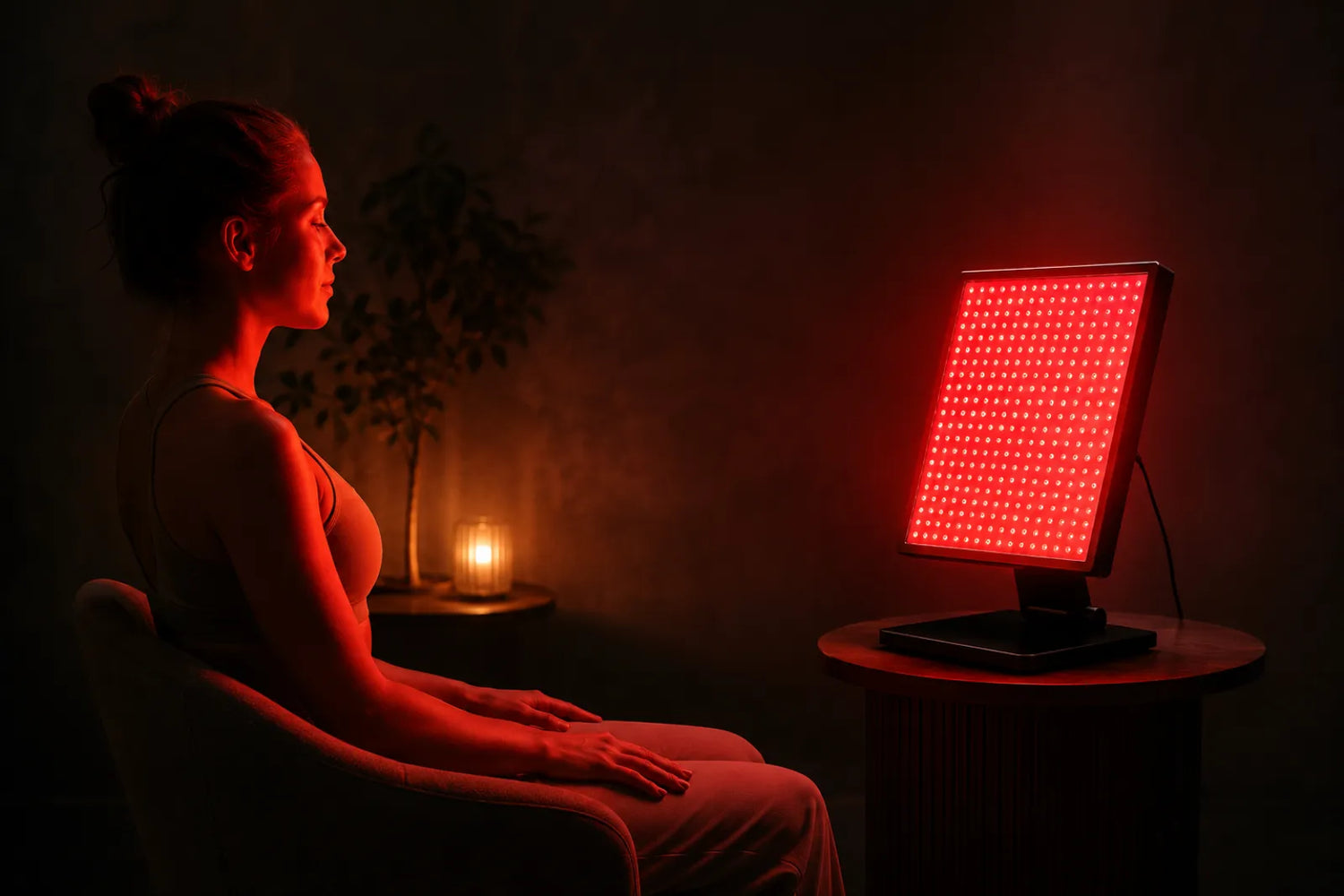
If you’ve bought a red light therapy panel, one of the first questions is usually the least glamorous one: how far away should you actually sit or stand from it?
Fair question. Distance affects how much light reaches your skin, how much area you cover, and how practical the session feels in real life. Get too far away and the dose can drop off. Get too close and you may make sessions less comfortable than they need to be.
The short version: there isn’t one magic distance that works for every goal. Facial skin routines, targeted recovery sessions, and larger-body treatments all benefit from slightly different setups. What matters is matching the distance to the device, the treatment area, and the result you want.
Still choosing a panel? Start with our best red light therapy panel UK 2026 guide, then come back here to dial in your distance.
The simple answer
For most at-home red light therapy panels, a practical starting point is:
- Face and skin-focused sessions: roughly 15 to 30 cm away
- Targeted muscle or joint sessions: roughly 15 to 45 cm away
- Larger coverage sessions: roughly 30 to 60 cm away
That is a starting range, not a universal law.
A more powerful panel can often be used from farther away. A smaller panel usually works best a bit closer. If your goal is high-intensity treatment on a small area, closer often makes sense. If your goal is broader coverage, stepping back can be more practical.
Why distance matters more than people think
Red light therapy is not just about wavelength. It is also about dose.
Dose depends on things like:
- Wavelengths used
- Irradiance, or power delivered to the skin
- Session length
- Distance from the device
- Frequency of use
As a general rule, the farther you move from a panel, the less light intensity reaches the body. That does not automatically make the session useless, but it does change the dose you are getting.
If you want to put numbers on it, our guide to red light therapy dosage, irradiance and joules shows how to work out the dose from a device's stated output and your session time.
This is one reason two people can use “red light therapy” and have very different experiences. One person is using a panel close enough for a focused 10-minute session. Another is standing much farther away and assuming the same session length will do the same job. It usually won’t.
Closer is not always better
A lot of marketing makes this sound like a brute-force game. More power. More intensity. More panels. More everything.
That is sloppy thinking.
Photobiomodulation tends to work within a therapeutic window. Too little light may not do much. Too much is not automatically better. The goal is an appropriate dose delivered consistently.
That is why a sensible setup beats macho overkill.
If you are using a panel for facial skin health, sitting at a practical distance for even coverage matters more than trying to blast your face from uncomfortably close range. If you are using it for a specific area like quads, shoulders, or lower back recovery, moving closer for a shorter, focused session may be more useful.
What the research suggests
Research on photobiomodulation shows that treatment parameters matter. Wavelength, power density, treatment time, and total energy delivered all influence outcomes. In plain English: the setup matters, not just the fact that the light is on.
Clinical and review literature has also noted that inconsistent dosing is one reason results can vary across studies and devices. That is especially relevant for home users, because distance is one of the easiest variables to control.
For skin-focused use, studies on red and near-infrared LED therapy have reported improvements in skin texture, collagen density, and wrinkle appearance when the treatment is delivered consistently over time. For muscle and recovery applications, reviews suggest photobiomodulation may support post-exercise recovery and reduce markers of fatigue, but the treatment approach still needs to be matched to the goal.
In other words: distance is not trivia. It is part of the treatment.
Best distance for facial skin routines
If you are using a panel for skin texture, glow, or the appearance of fine lines, you generally want:
- even coverage across the face
- a comfortable position you can repeat regularly
- enough intensity without making the session awkward
For many people, that means sitting or standing around 15 to 30 cm away.
That range usually gives a good balance between coverage and intensity. It is close enough to keep the session effective, but not so close that you are craning into the device like you are being interrogated.
If your main goal is facial use, a dedicated LED face mask is often the easier choice because it keeps the distance effectively fixed and delivers consistent facial coverage.
A panel can still work well for the face, especially if you want more flexibility, but it helps to keep your setup repeatable.
Best distance for targeted muscle recovery
If you are targeting one area after training, such as calves, shoulders, hamstrings, or lower back, it often makes sense to move a bit closer.
A useful range for targeted work is often 15 to 45 cm, depending on:
- the panel’s power output
- the size of the treatment area
- whether you are seated or standing
- the recommended session length from the manufacturer
This is where larger targeted devices can make sense. The Lumovex Pro Panel 540 is better suited to larger treatment zones, while the Portable LED Panel is handy when you want focused sessions on smaller areas or while travelling.
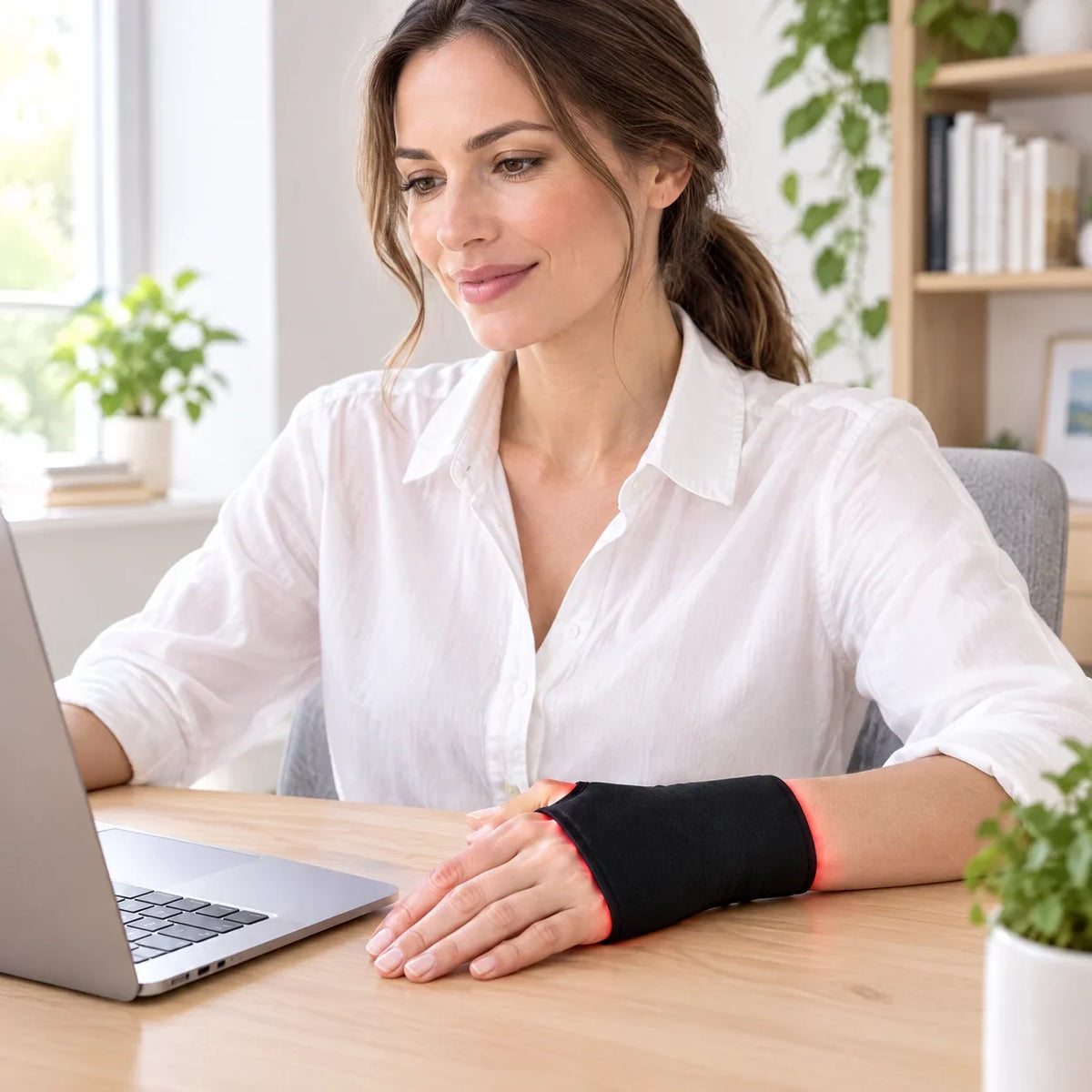
For wraparound areas like the waist or lower back, a wearable device such as the Lumovex Red Light Therapy Belt may simply be the more practical option.
Best distance for bigger coverage sessions
If you are trying to cover a larger area, stepping back slightly can help spread the light across more of the body.
A common range here is 30 to 60 cm.
The trade-off is straightforward:
- Farther away: more coverage, lower intensity
- Closer: higher intensity, less coverage
That trade-off is why there is no universal “best” distance. It depends on whether you care more about treating one spot properly or covering more surface area in one go.
How to tell if you are too far away
You are probably too far away if:
- your sessions are very short but you are treating from a large distance
- you are trying to cover a small area but standing far back anyway
- you are relying on guesswork instead of a consistent setup
- you expect fast results from a low-intensity, occasional routine
This does not mean every farther-distance session is pointless. It means you need to understand the trade-off.
If you move farther away, you may need a longer session or a different device setup to keep the dose sensible.
How to tell if you are too close
Too close is less about danger in the dramatic sense and more about practicality.
Your setup may be too close if:
- coverage becomes too narrow for the area you want to treat
- the session feels awkward or uncomfortable
- you struggle to keep the same position each time
- you assume more intensity is always better
Comfort matters because consistency matters. The best protocol is the one you will actually stick to.
A practical way to choose your distance
If you do not know where to start, use this framework:
1. Decide the goal first
Ask yourself what the session is actually for.
- Face and skin quality: prioritise even facial coverage
- One muscle group or joint: prioritise focused intensity
- General larger-area session: prioritise coverage
2. Start in the middle, not at an extreme
For most home users, beginning around 20 to 30 cm away is a sensible baseline. Then adjust based on the area you are treating and the device you are using.
3. Keep one variable stable
Do not change distance, duration, and frequency all at once. Pick a distance, stick with it for a couple of weeks, and assess whether the routine is practical and repeatable.
4. Follow the device guidance
Manufacturer guidance matters because power output differs between devices. A powerful full-size panel and a small portable unit should not be treated as interchangeable.
Panel vs LED face mask: which is easier?
If your main goal is facial skin support, an LED face mask usually wins on convenience. You do not need to think much about distance or positioning. That makes it easier to build a repeatable routine.
If you want flexibility across face and body, a panel is the more versatile tool. You can use it for facial sessions, post-workout recovery, and targeted treatment on different areas. You just need to be a bit more intentional about setup.
The right answer is not “mask or panel forever.” It is: use the format that matches your real routine.
Common mistakes people make
Assuming all panels should be used the same way
They should not. Output, treatment area, and intended use vary.
Standing too far away for convenience
Convenience is fine. Pretending it changes nothing is not.
Copying someone else’s setup exactly
Your goal may be completely different from theirs.
Chasing intensity instead of consistency
A clean routine you repeat four times a week beats a chaotic “max power” session you do twice and abandon.
The bottom line
A good starting distance for a red light therapy panel is usually somewhere between 15 and 45 cm, with smaller facial sessions often closer and broader coverage sessions slightly farther back.
If you want the simplest rule: get close enough for a meaningful dose, but not so close that coverage or comfort becomes a problem.
That is the real answer. Not sexy, but useful.
If you want a simpler facial routine, the Lumovex Spectrum Pro LED face mask keeps things easy. If you want flexible targeted sessions across different body areas, the Lumovex Pro Panel 540 or Portable LED Panel make more sense.


Leave a comment
This site is protected by hCaptcha and the hCaptcha Privacy Policy and Terms of Service apply.