

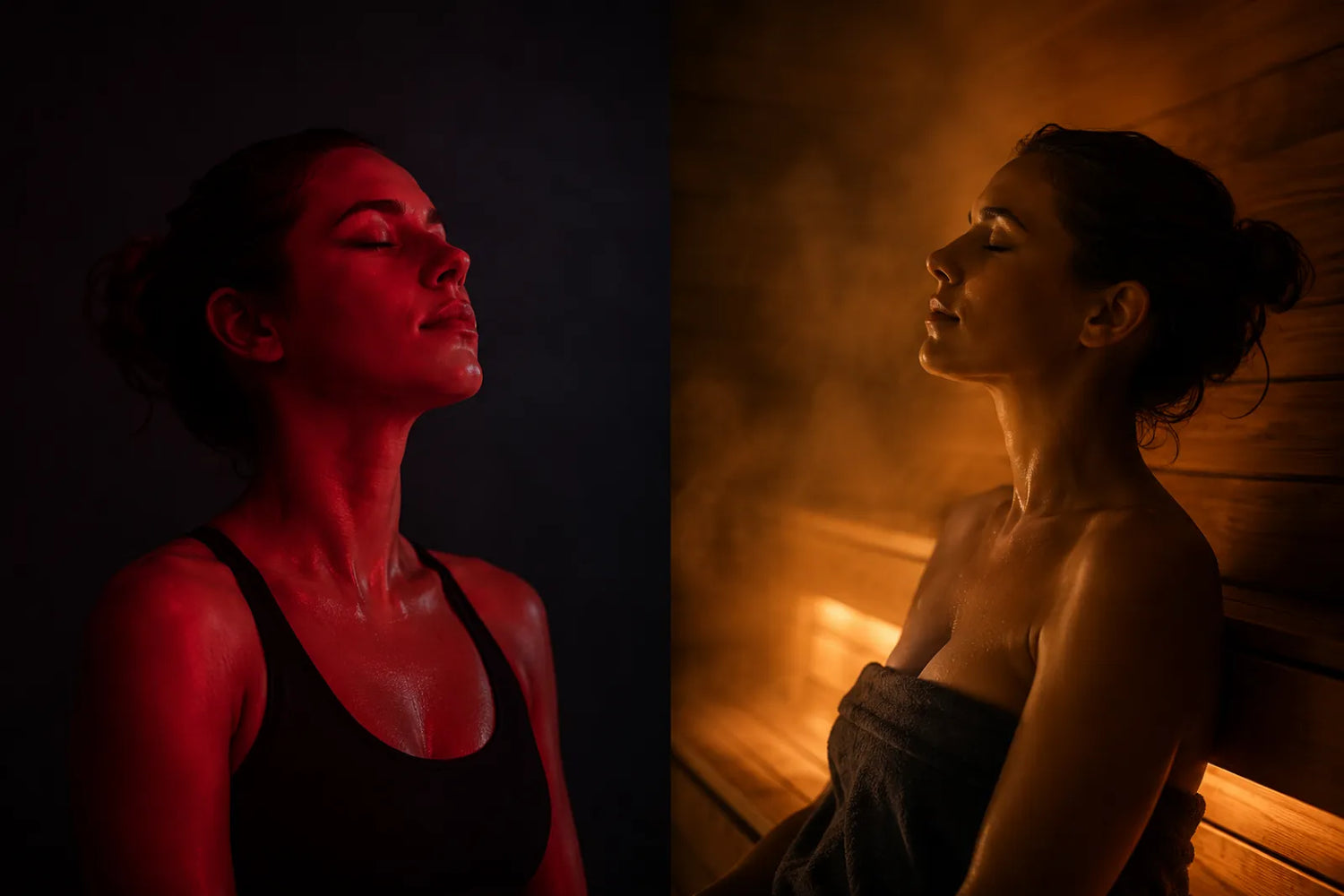
Walk into any wellness centre and you'll probably find both red light therapy panels and infrared saunas. They sound similar. They both involve infrared. But they work in completely different ways, and understanding those differences helps you decide what actually makes sense for your goals. Below is the difference between red light therapy and an infrared sauna, what each one does, and whether it is worth using both.
How Infrared Saunas Work
Infrared saunas heat your body directly using far-infrared radiation (typically 5,000 to 15,000nm wavelengths). Unlike traditional saunas that heat the air around you, infrared saunas warm your tissues from within.
The primary mechanism is heat. Your core temperature rises, you sweat, blood vessels dilate, and circulation increases. The therapeutic effects come from this controlled heat stress, similar in spirit to the benefits of exercise-induced heat.
Research-backed benefits include:
- Improved cardiovascular function
- Enhanced circulation and blood flow
- Relaxation and stress reduction
- Support for muscle recovery through increased blood flow
How Red Light Therapy Works
Red light therapy (photobiomodulation) uses specific wavelengths of visible red (630 to 670nm) and near-infrared (810 to 850nm) light. These wavelengths penetrate skin and tissue, where they're absorbed by chromophores in your cells, particularly cytochrome c oxidase in the mitochondria.
The primary mechanism is photochemical, not thermal. The light energy triggers cellular responses without significantly heating tissue. Your cells absorb the photons and convert them into cellular energy (ATP), supporting a range of biological processes.
Research-backed benefits include:
- Enhanced cellular energy production (ATP synthesis)
- Support for collagen production and skin health
- Reduced oxidative stress in cells
- Support for muscle recovery and reduced delayed-onset muscle soreness
- Support for the body's wound healing response
Key Differences at a Glance
| Factor | Infrared Sauna | Red Light Therapy |
|---|---|---|
| Primary mechanism | Heat (thermal) | Light absorption (photochemical) |
| Wavelengths | Far-infrared (5,000-15,000nm) | Red (630-670nm) + NIR (810-850nm) |
| Temperature increase | Significant | Minimal to none |
| Session duration | 15-30 minutes | 10-20 minutes |
| Sweating | Yes, significant | No |
Can You Use Both?
Yes, many people do, but timing matters.
- RLT before sauna: cells are "primed" with energy before the heat stress
- RLT after sauna: increased circulation helps distribute the cellular benefits
- Separate sessions: sauna in the morning, red light in the evening
Practical note: don't use red light devices inside a sauna, as heat can damage the electronics.
Which One Do You Need?
Choose an infrared sauna if:
- Relaxation and stress relief are your primary goals
- You enjoy the sweating ritual
- Cardiovascular conditioning is a focus
Choose red light therapy if:
- Skin health and collagen support matter to you
- You want targeted treatment for specific areas
- You prefer shorter, non-sweating sessions
- You want something for daily home use
The Home Use Reality
Installing an infrared sauna at home requires space, electrical work, and significant investment (often £1,500 to £8,000+). Red light therapy devices are far more accessible. A quality panel like the Lumovex Pro Panel 540 delivers high-output wavelengths without dedicated room renovations. For facial focus, the Spectrum Pro Mask offers targeted treatment in 10-minute sessions, and the Sculpt Wand handles precision areas. Many people start with red light therapy at home and use infrared saunas at the gym or spa, getting the benefits of both without the infrastructure. See the full body recovery range for panels, belts and mats.
Frequently Asked Questions
Is an infrared sauna the same as red light therapy?
No. A sauna works through heat (far-infrared in the thousands of nanometres), while red light therapy works through light absorbed by your cells (red and near-infrared in the hundreds of nanometres). Different mechanisms, different benefits.
What is the difference between red light therapy and an infrared sauna?
An infrared sauna heats your whole body to raise your core temperature and make you sweat. Red light therapy uses specific red and near-infrared wavelengths that your cells absorb to support energy, skin and recovery, with little to no heat. Same family of light, very different effect.
Is there such a thing as a red light sauna?
Some cabins combine sauna heat with red or near-infrared LEDs, but that is different from dedicated red light therapy. A true red light therapy device delivers controlled 660nm and 850nm wavelengths at the right intensity, which a heat-first sauna is not designed to do.
Does red light therapy make you sweat?
No. It does not meaningfully heat the body, so there is no sweating. If you want the sweat-and-heat experience, that is a sauna.
Which is better for skin?
Red light therapy, clearly. Its wavelengths are specifically associated with collagen support and skin health. A sauna's benefits for skin are mostly indirect, via circulation.
Do I need both?
No. They are complementary, not competing. Many people are well served by red light therapy alone, especially for skin and targeted recovery.
The Bottom Line
Red light therapy and infrared saunas aren't competitors, they're complementary tools that work through completely different mechanisms. One heats your body to trigger circulation and cardiovascular responses. The other delivers specific light wavelengths to support cellular energy production. You don't need both, but understanding what each actually does helps you make informed choices rather than chasing trends. If you are weighing up devices, our red light therapy comparison guide breaks down exactly what to look for.




Leave a comment
This site is protected by hCaptcha and the hCaptcha Privacy Policy and Terms of Service apply.