

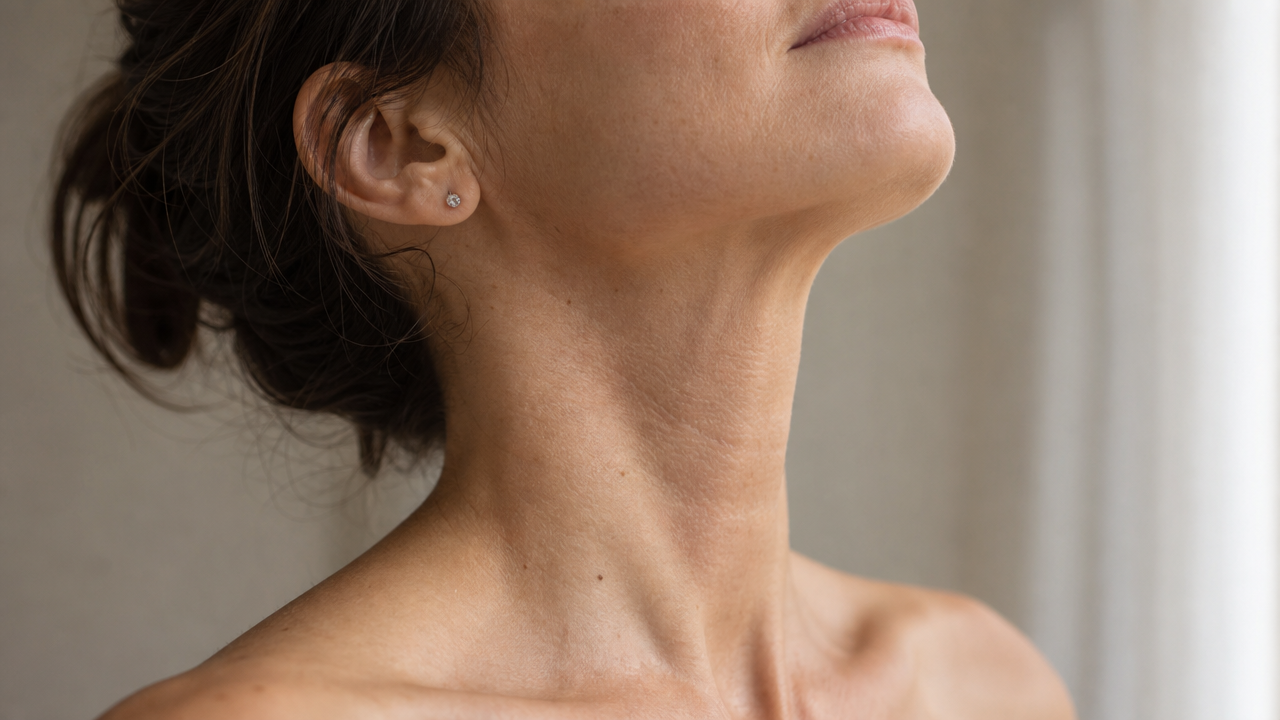
The neck is where age shows first, and it is the one place most skincare routines forget. You can spend years perfecting your facial regime and still stop dead at the jawline. Here is what red light therapy can realistically do for a crepey, creping neck, what it cannot do, and how to treat your face and neck as one.
Why your neck ages faster than your face
The skin on your neck is thinner than the skin on your face, has fewer oil glands to keep it supple, and sits over muscle that is in near-constant motion every time you talk, swallow or look down at a phone. That last habit has its own nickname now, "tech neck", and it describes the horizontal creping and loss of firmness that appears earlier than most people expect. Add fewer sebaceous glands, more sun exposure (the neck is easy to miss with SPF) and a thinner support structure, and you have skin that shows crepiness, fine lines and early laxity sooner than the face above it.
The questions people actually ask
When you look at what people genuinely ask before buying a device, the same worry comes up again and again: will this actually tighten loose neck skin, or is it a waste of time? People talk about "turkey neck", jowls, sagging under the chin, and crepey texture that catches the light. So let us answer the real question honestly rather than the marketing one.
What red light therapy can realistically do for the neck
Red and near-infrared light therapy, properly called photobiomodulation, has reasonable evidence behind it for skin texture and fine lines, and there is now direct neck data. A 2025 multicentre, randomised, double-blind, sham-controlled trial published in the Journal of Cosmetic Dermatology (Park and colleagues) tested a home-use LED neck device: participants used it for nine minutes a day, five days a week, and the treated group showed measurable improvement in neck wrinkle scores compared with the sham device. Earlier work from Barolet and colleagues found that 660nm LED light improved facial wrinkles and increased collagen in the skin. In the lab, red light has been shown to stimulate fibroblasts, the cells that produce collagen and elastin.
Put plainly: red light therapy may help with crepey texture, fine lines, surface crepiness and mild early laxity on the neck. It is designed to support the skin's own collagen production over time, not to deliver an overnight change.
What it will not do, and why honesty matters here
It will not lift structural sagging. If the issue is genuine jowls or significant loose skin from lost volume and slackened deeper tissue, that is a job for a surgical or energy-based clinical procedure, not a light. Any brand promising a facelift in a mask is overselling. Red light works at the level of the skin and its collagen, so it is best understood as a tool for quality and texture, not architecture. Knowing that boundary is the difference between being pleased with your results and being disappointed.
Is it safe to use over the thyroid?
This is a fair question, because the thyroid sits at the front of the neck. The same 2025 neck trial specifically examined the thyroid gland with ultrasound before and after the treatment course and found no adverse changes, and a separate study in the Journal of Clinical Medicine assessing home LED use on the neck reported no significant changes to thyroid structure or function after sixteen weeks. On current evidence, home-use LED light at these wavelengths is not considered a thyroid risk, though if you have a diagnosed thyroid condition it is always sensible to check with your doctor first.
Treat the face and neck as one
The practical problem is that most LED masks stop at the jawline, so even diligent users leave the neck untreated. The Lumovex Spectrum Pro Mask and Neck set is built to cover both in a single session. The mask carries 328 LED points across four wavelengths (green 525nm, yellow 590nm, red 660nm and near-infrared 850nm), and the neck attachment adds a further 60, for 388 LED points treating the full face and neck together in one ten-minute routine. Red at 660nm and near-infrared at 850nm are the wavelengths most studied for collagen and skin firmness, and treating the neck at the same time as the face means the area that ages first stops being the area you always skip.
If you only ever treat your face, you are doing half a routine. Face and neck age together, so it makes sense to treat them together.
How long before you see a difference
Photobiomodulation is a consistency tool, not a quick fix. In the clinical trials, results were measured after weeks of near-daily use, not days. Realistically, plan for a daily or near-daily ten-minute session and give it eight to twelve weeks before you judge it. Skin turns over slowly, and collagen changes are gradual by nature.
The honest bottom line
Red light therapy is one of the better-evidenced at-home options for improving crepey neck texture, fine lines and mild laxity, and the neck now has its own controlled trial behind it. It will not replace surgery for structural sagging, and it rewards patience. Used consistently, across the face and neck together, it is a sensible, low-effort addition to a routine, not a miracle, but a genuinely useful one.
Frequently asked questions
Does red light therapy tighten loose neck skin?
It may help with crepey texture, fine lines and mild early laxity by supporting collagen, but it will not lift significant structural sagging or true jowls, which need a clinical procedure.
How often should I use it on my neck?
Most studies used the device around five to seven days a week for roughly nine to ten minutes per session. Consistency matters more than long individual sessions.
Is it safe over the thyroid?
Trials that specifically examined the thyroid with ultrasound found no adverse changes at home-use LED wavelengths. If you have a thyroid condition, check with your doctor first.
Can I treat my face and neck at the same time?
Yes. A combined mask and neck device such as the Lumovex Spectrum Pro Mask and Neck set covers both in one session, which is the simplest way to stop neglecting the neck.




Leave a comment
This site is protected by hCaptcha and the hCaptcha Privacy Policy and Terms of Service apply.